
Seven rhymed hunting jokes, a theatrical woodland, and one well-used studio prop bring the French postcard age to life.
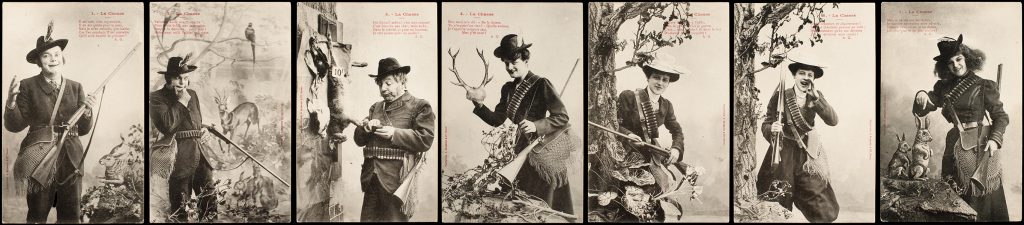
Somewhere in a photographer’s studio at the height of France’s postcard craze, a performer shoulders a Lefaucheux-system pinfire shotgun and offers a cheerful explanation for the rabbit he has failed to shoot. The animal escaped with only a fright, he says, and by next year it will be twice as large. This is the opening joke in La Chasse, a series of seven numbered postcards in which every hunt goes agreeably off course.
The woods are an assortment of painted scenery, arranged branches, artificial undergrowth, and animal props. Feathered hats, game bags, cartridge belts, and the same pinfire shotgun reappear as the performers change. The actors supply broad expressions and knowing looks, while a short verse printed in red completes each scene. Together, the seven cards resemble a sequence of music-hall sketches reduced to postcard size.
A comedy made for the postcard age
The imprint running along the edge of each card reads “Phototypie A. Bergeret & Cie, Nancy.” Albert Bergeret had established his own printing concern in Nancy in 1898, just as the illustrated postcard was becoming one of Europe’s most popular forms of inexpensive communication and entertainment. His production rose from 25 million cards in 1900 to 75 million in 1903, filling shops and albums with city views, military subjects, sentimental scenes, artists’ designs, and staged comic fantasies such as La Chasse.
The word phototypie refers to the printing process, known in English as collotype. A photographic negative was transferred through a light-sensitive gelatin surface on glass, producing an image with fine tonal detail and no visible halftone screen. Bergeret printed the titles and verses separately in red, giving these cards the appearance of photographs accompanied by little pieces of printed theater.
Their format also helps date them. Early French picture postcards generally reserved the entire address side for the recipient’s address, so the sender had to squeeze any message into open space on the picture side. A surviving mailed example of the first La Chasse card bears a Paris postmark of September 16, 1903. The postmark, undivided back, Bergeret imprint, and fashions all support a date of circa 1903.
The seven cards form a complete numbered sequence. For contemporary buyers, that numbering added another pleasure: finding each scene and assembling the whole comic hunt in an album.
Each verse is signed “A. G.,” the initials of Armand Gaboriaud, a prolific writer for Bergeret who also used the pen name Marcel Houjan. Gaboriaud wrote in a lively, colloquial style filled with dropped syllables, mild oaths, slang, and double meanings. His lines were designed to be read with the photograph, since the crucial part of the joke was often sitting in the actor’s hand or lurking among the studio foliage.
The photographer and performers were left uncredited. Georges Morinet of Nantes is a possible photographer. He supplied Bergeret with thousands of staged negatives during this period and regularly worked with theatrical performers whose faces recur across different comic series. No surviving record currently connects Morinet directly with La Chasse, so the photographer’s identity remains open.
Gaboriaud’s verses are transcribed below as printed. The English translations favor the sense and humor of the originals, since several of the rhymes depend on period slang and visual puns.
The rabbit that got away
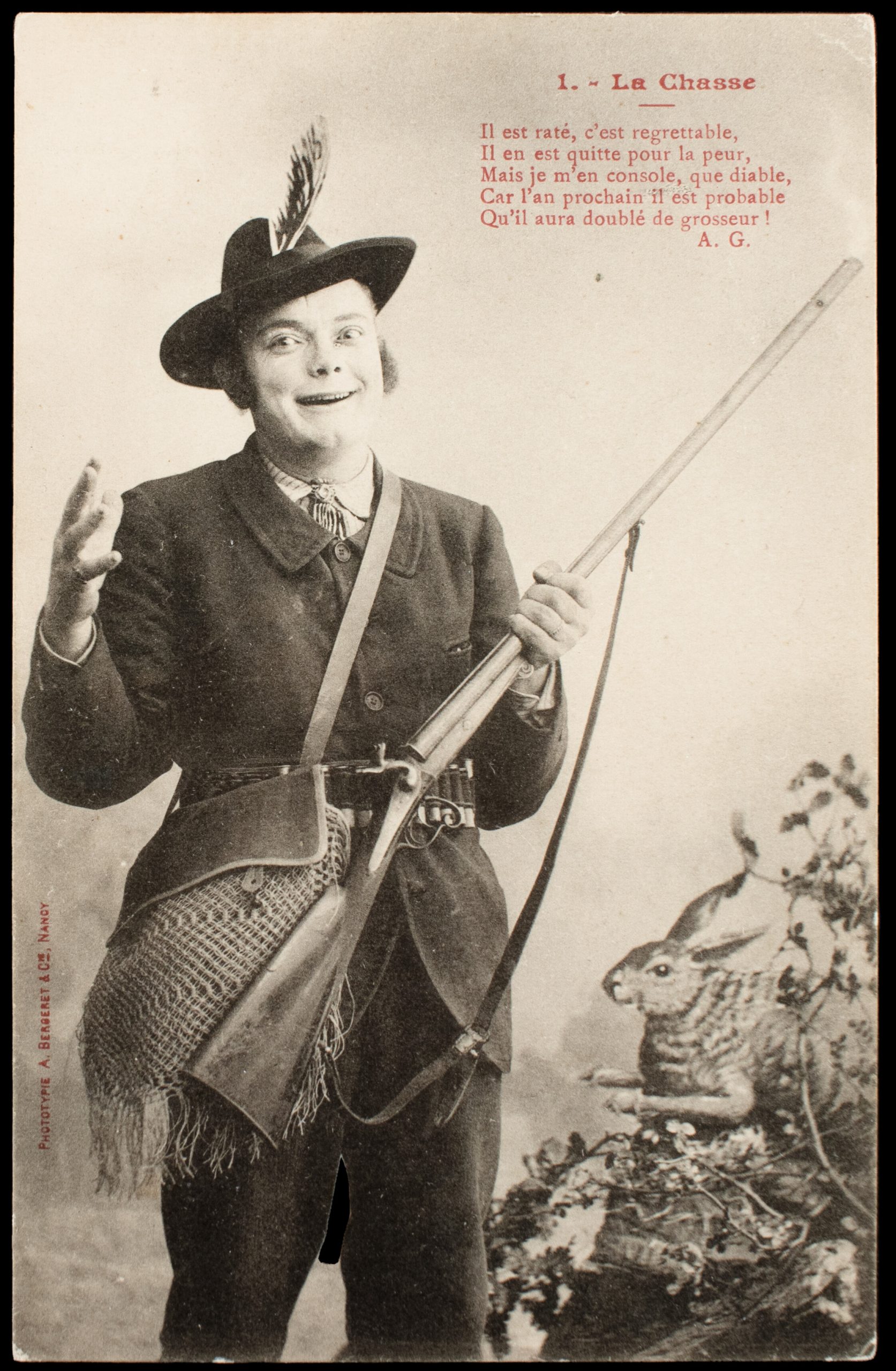
The first hunter stands before the camera with his gun broken open, his game bag hanging empty, and an expression of complete satisfaction. The rabbit beside him has survived, which merely gives the sportsman something larger to look forward to next season.
Il est raté, c’est regrettable,
Il en est quitte pour la peur,
Mais je m’en console, que diable,
Car l’an prochain il est probable
Qu’il aura doublé de grosseur !
A. G.
Translation: “I missed him, which is regrettable. He got away with nothing worse than a fright. Still, what the devil, I can console myself: next year he will probably have doubled in size!”
His reasoning is wonderfully convenient. A clean miss has become an investment, and the rabbit’s escape promises a grander trophy later.
The game arrives too late
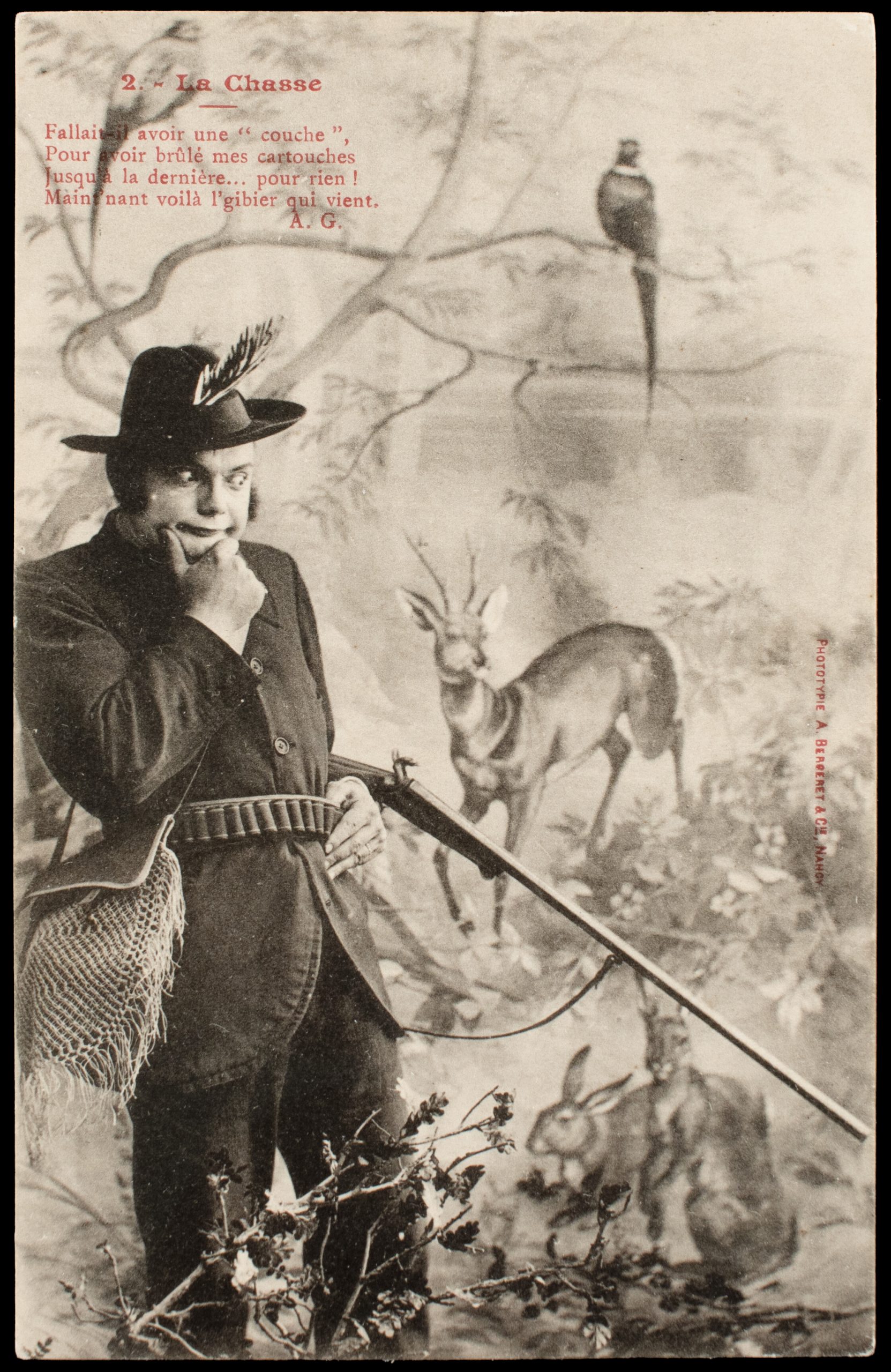
The same unfortunate hunter has now fired every cartridge without troubling any game. Only after the last shot has been wasted do the animals gather behind him.
Fallait-il avoir une « couche »,
Pour avoir brûlé mes cartouches
Jusqu’à la dernière… pour rien !
Maint’nant voilà l’gibier qui vient.
A. G.
Translation: “How thick I must have been, to fire my cartridges down to the last one… for nothing! And now here comes the game.”
The quotation marks around couche signal period slang. To en avoir une couche meant to be thick, foolish, or stupid, while brûler ses cartouches meant to expend one’s ammunition. The hunter’s belt remains visibly full despite his claim to have fired everything, an early hint that accuracy in the prop department was secondary to a good picture.
Ten francs for a reputation
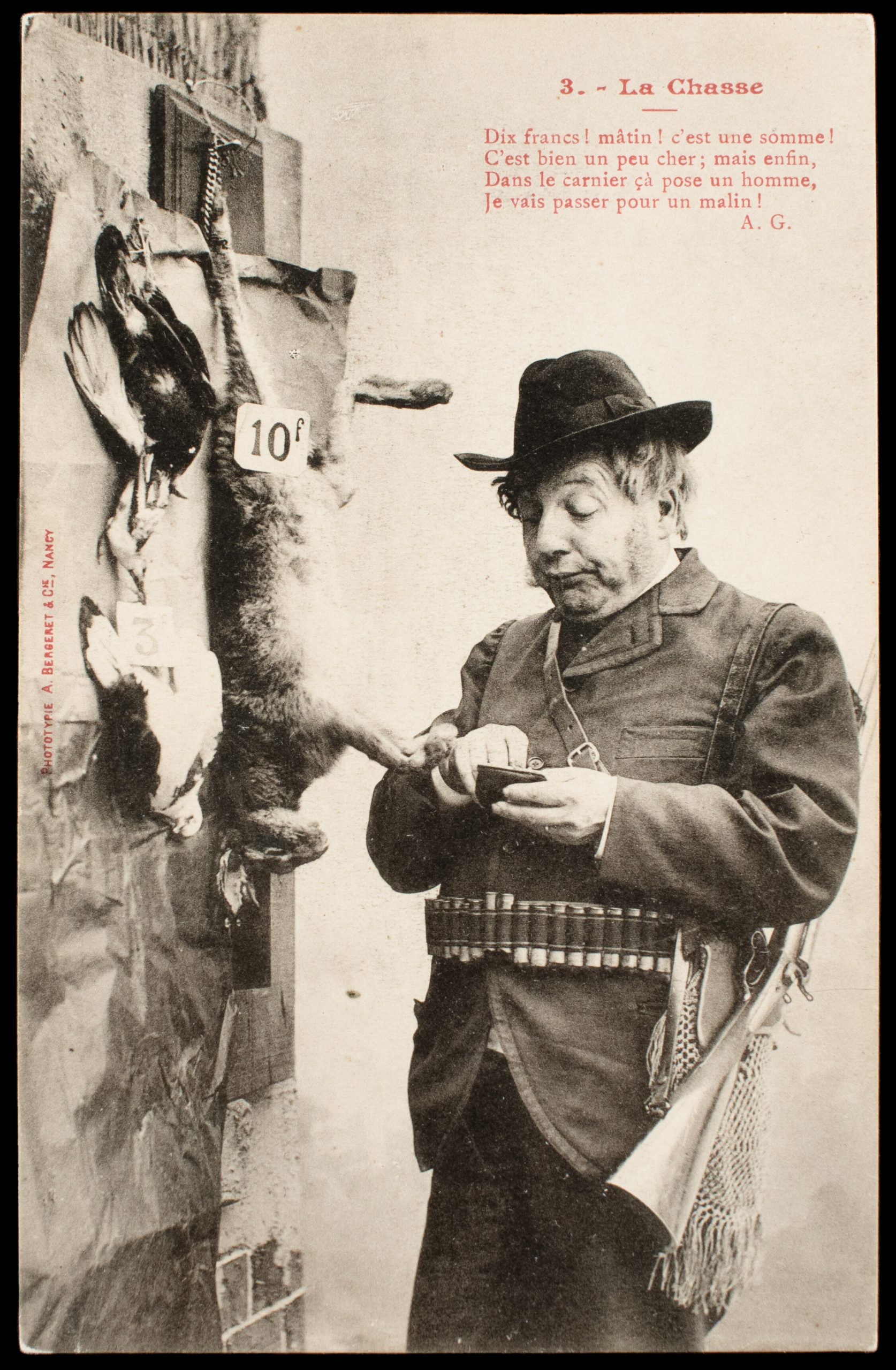
Card 3 moves away from missed shots and finds another route to sporting success. A row of game hangs for sale with a large “10 f” placard, and the hunter is already opening his wallet.
Dix francs ! mâtin ! c’est une somme !
C’est bien un peu cher ; mais enfin,
Dans le carnier çà pose un homme,
Je vais passer pour un malin !
A. G.
Translation: “Ten francs! Good heavens, that is a sum! It is rather expensive, but once it is in the game bag it will make a man look impressive. Everyone will take me for a clever fellow!”
The carnier is his game bag, and ça pose un homme means that it gives a man standing or makes him cut an impressive figure. Ten francs buys the evidence of a successful day, along with the admiration he expects to receive when he carries it home.
A present for her husband
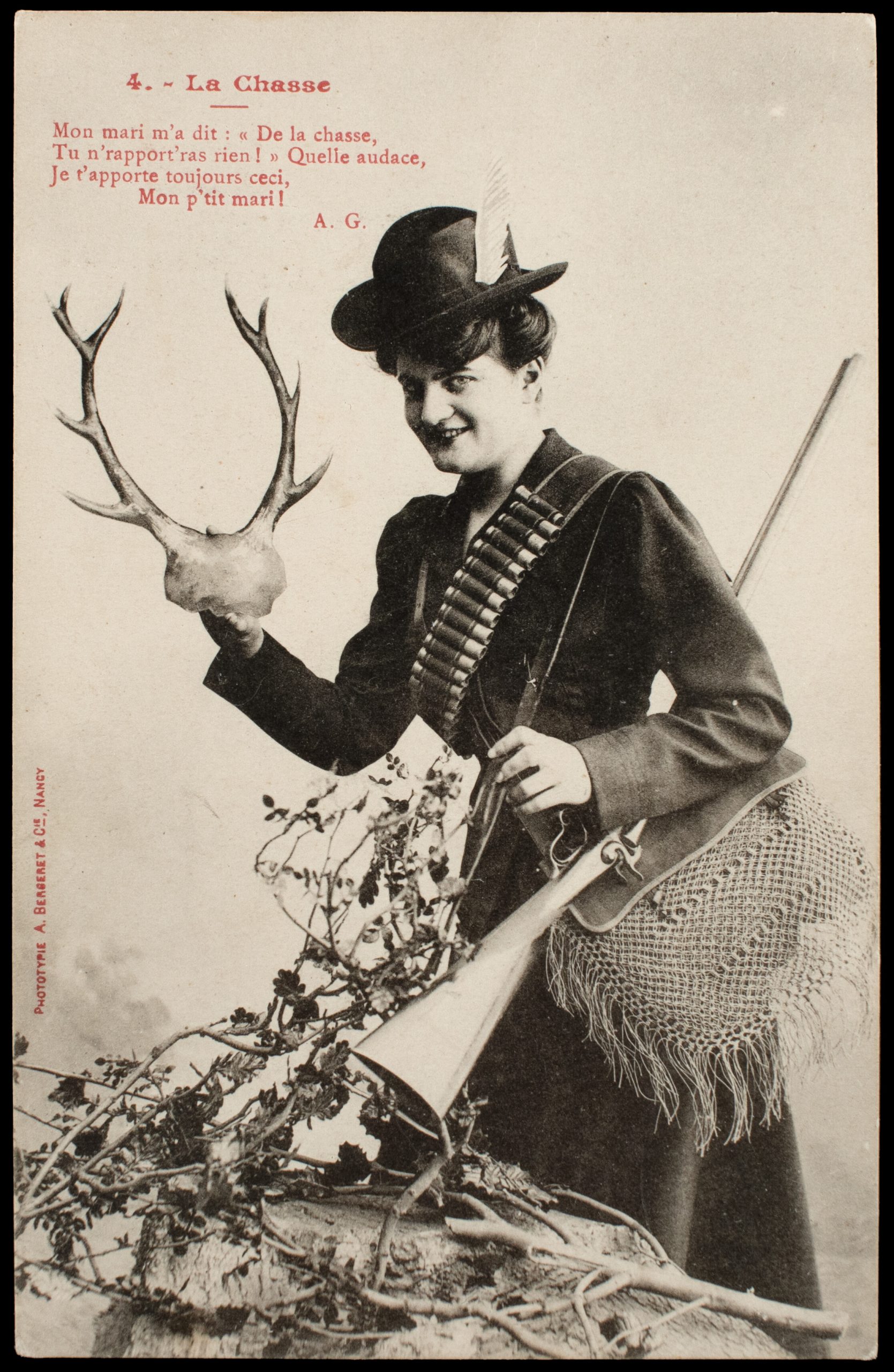
The fourth card introduces a huntress whose husband has confidently predicted that she will return empty-handed. She answers him while holding up a splendid set of antlers.
Mon mari m’a dit : « De la chasse,
Tu n’rapport’ras rien ! » Quelle audace,
Je t’apporte toujours ceci,
Mon p’tit mari !
A. G.
Translation: “My husband told me, ‘You will bring nothing back from the hunt!’ What cheek. I always bring you this, my dear little husband!”
Gaboriaud leaves the word “horns” out of the verse because the photograph supplies it. In French, a husband whose wife was unfaithful was said to wear horns. The huntress has therefore brought home a trophy with a pointed message for her petit mari.
Hunting for a cousin
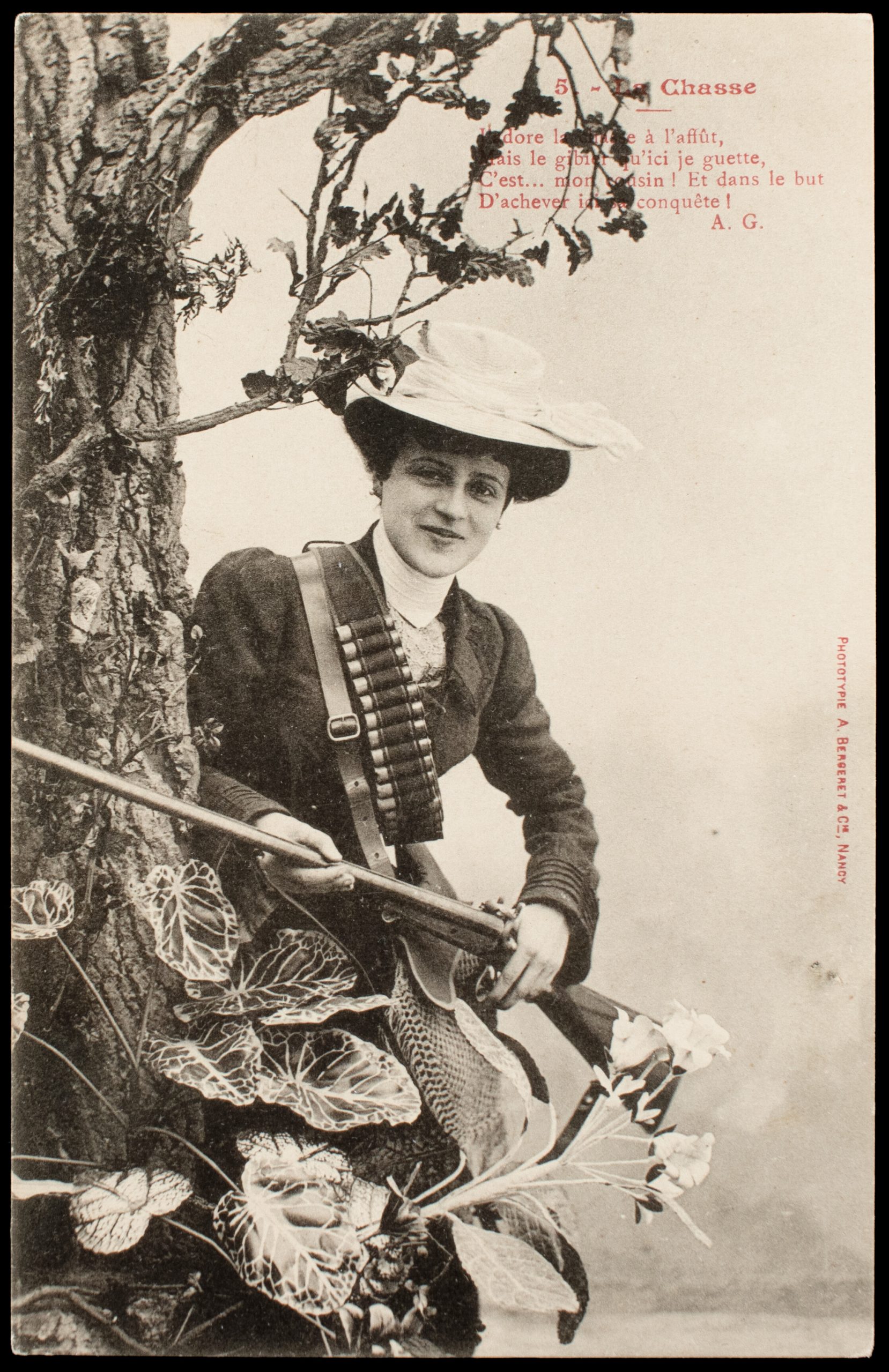
With cards 5 and 6, the hunt becomes a courtship. The first woman waits beside a studio tree with shotgun, game bag, and bandolier, although the quarry she has in mind is her cousin.
J’adore la chasse à l’affût,
Mais le gibier qu’ici je guette,
C’est… mon cousin ! Et dans le but
D’achever ici ma conquête !
A. G.
Translation: “I love hunting from ambush, but the game I am watching here is… my cousin! I intend to complete my conquest here.”
The hunting vocabulary does nearly all the work. À l’affût means lying in wait, gibier is game, and guetter means to watch for something from concealment. Her cousin has become the quarry, and conquête carries the additional meaning of a person romantically won over.
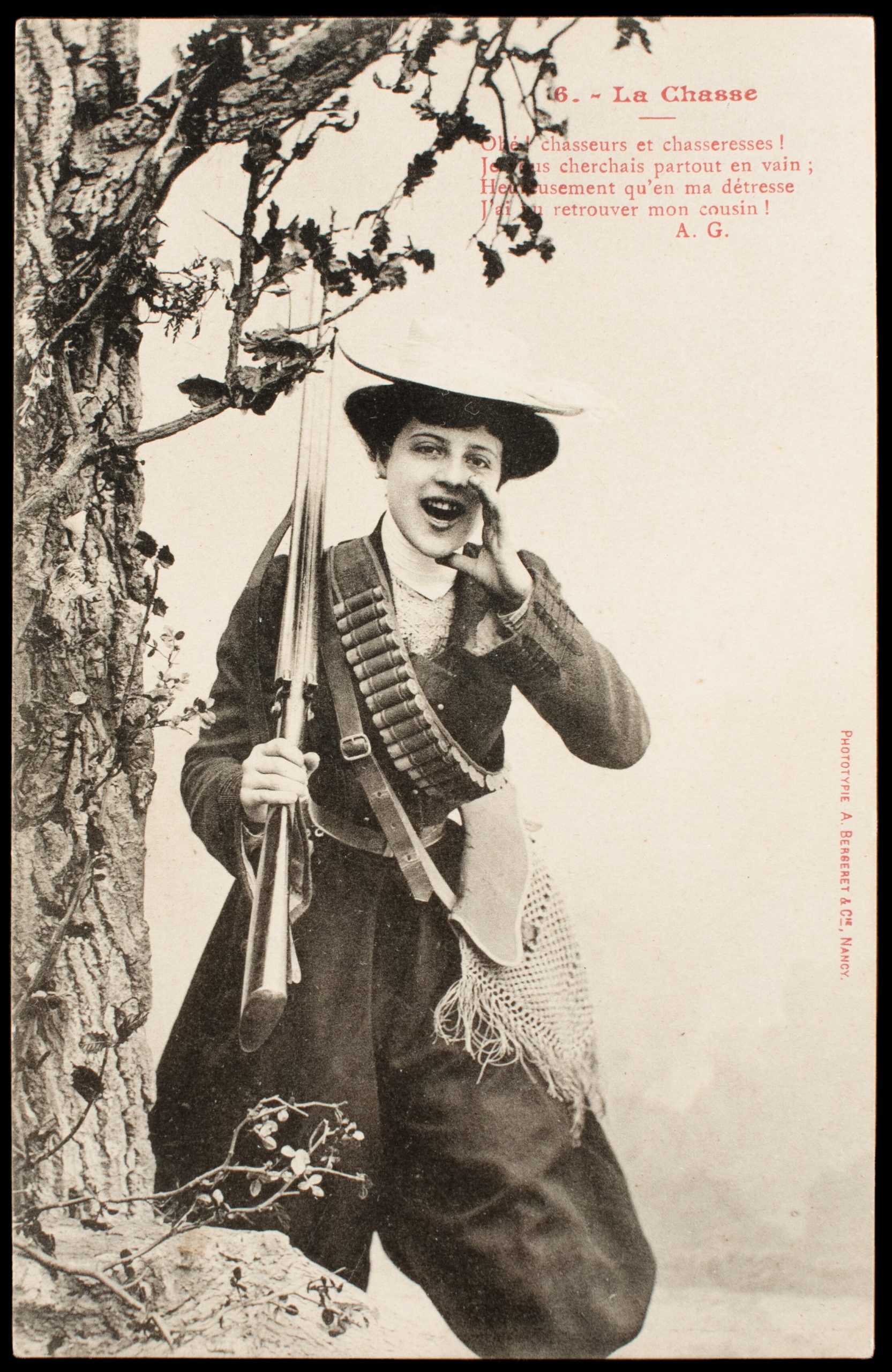
The next card continues the joke with another smiling huntress calling out to the rest of the party. Whatever happened beyond the edge of the picture, the cousin has been successfully found.
Ohé ! chasseurs et chasseresses !
Je vous cherchais partout en vain ;
Heureusement qu’en ma détresse
J’ai pu retrouver mon cousin !
A. G.
Translation: “Halloo, hunters and huntresses! I searched everywhere in vain; fortunately, in my distress, I managed to find my cousin again!”
The deliberately explicit chasseurs et chasseresses welcomes hunters of both sexes, and her broad smile suggests that recovering the cousin has rescued the outing quite thoroughly.
The huntress who trains rabbits
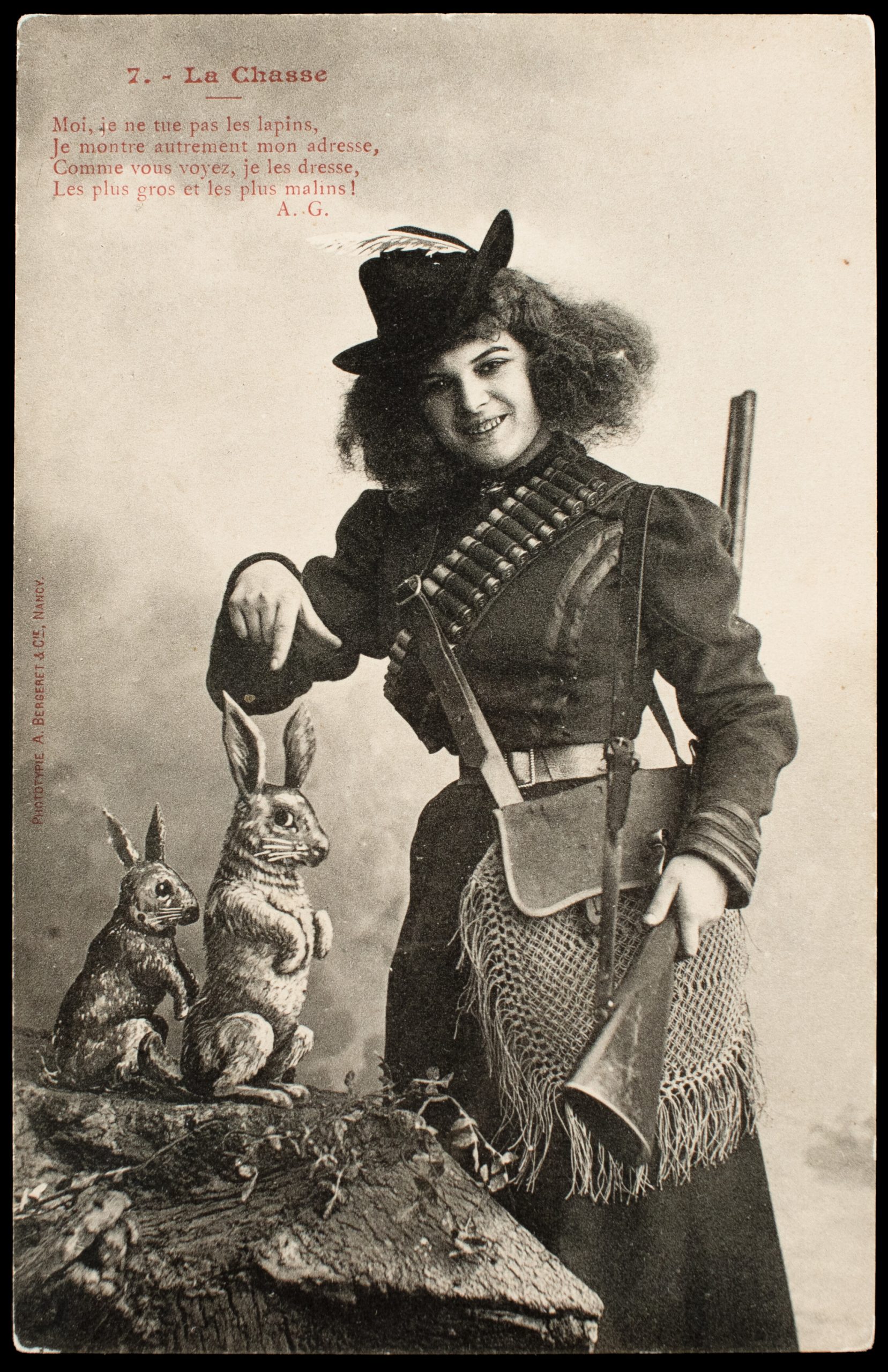
The series ends with two rabbits sitting obediently upright beside a huntress. Her achievement lies in what she has taught them to do.
Moi, je ne tue pas les lapins,
Je montre autrement mon adresse,
Comme vous voyez, je les dresse,
Les plus gros et les plus malins !
A. G.
Translation: “I do not kill rabbits. I show my skill another way: as you can see, I train them, even the biggest and cleverest!”
Adresse means skill or dexterity, and dresser means to train an animal. The word also suits the visual joke because the rabbits have literally been arranged upright. For readers holding the card in their hands, adresse may even have carried a faint echo of the postal address written on the other side.
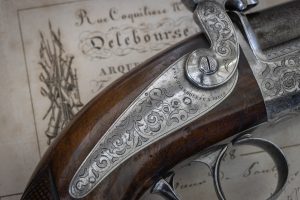
Throughout the comedy, the Lefaucheux-system pinfire shotgun remains part of the costume. Its external hammers curl forward over the breech to strike the projecting pins of pinfire cartridges, and the twin barrels and double triggers appear clearly from several angles. In 1903 the system represented an earlier generation of cartridge arms, and its distinctive profile still carried immediate meaning as a hunter’s gun.
The ammunition belts add a useful complication. Every visible belt appears to be filled with centerfire paper shotshells. Card 7 makes the distinction especially clear because several cartridge heads face the camera, revealing central primers and no projecting side pins. These shells would not function in the pinfire shotgun as shown.
Studio practicality offers the most likely explanation. The shotgun had a handsome silhouette, the external hammers read clearly in a photograph, and the cartridge belts completed the costume. Mechanical compatibility had no role in the joke. The accidental combination now places two generations of sporting ammunition in the same image and shows how readily an older pinfire gun could remain in circulation as a visual symbol.
These postcards preserve the public life of the Lefaucheux system in a form that surviving firearms alone cannot supply. They show the pinfire shotgun entering popular comedy as a familiar object, carried by theatrical hunters whose excuses, ambitions, and flirtations could be understood at a glance. The gun needed no introduction because the audience already knew what it represented.
More than a century later, La Chasse still works because Gaboriaud’s humor is rooted in recognizable human vanity and self-deception. Around the jokes, the cards have also preserved Bergeret’s great postcard industry, a cast of forgotten performers, and a small but revealing moment in the cultural history of the pinfire gun.