

Théodore Levigne’s Les chasseurs and the everyday presence of pinfire technology
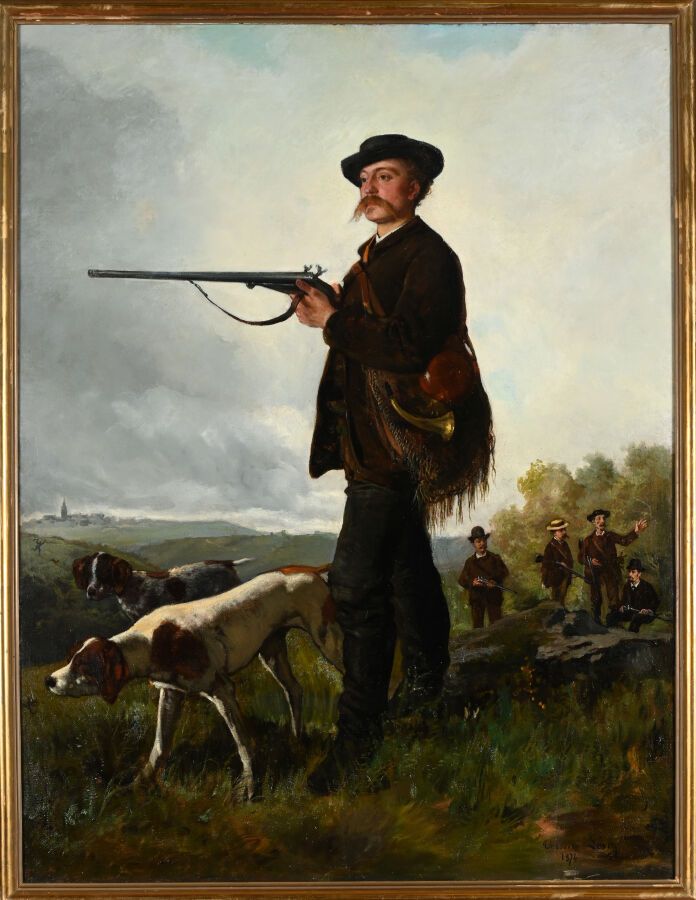
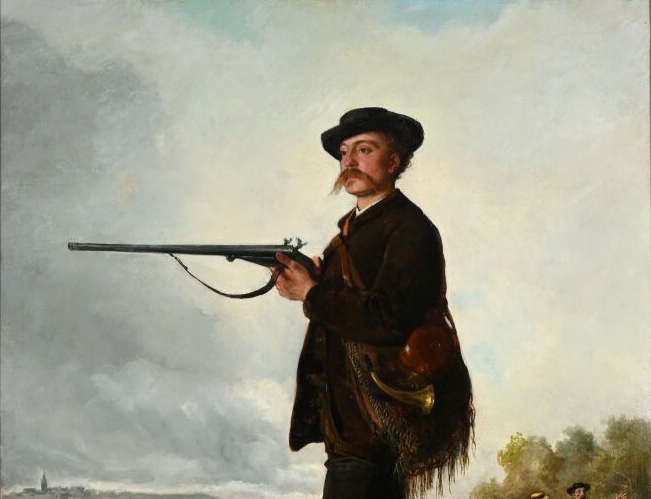
Théodore Levigne’s Les chasseurs, painted in 1874, is important not only as a finely observed hunting scene, but also as a rare visual document of firearms culture in nineteenth-century Europe. At first glance, the painting appears straightforward. A hunter stands in the foreground with two dogs, while several companions gather behind him in a broad rural landscape. The scene is calm, balanced, and natural. Nothing in it feels theatrical. Yet this quiet realism is exactly what makes the work so significant.
The central figure carries a Lefaucheux pinfire sporting gun. That detail transforms the painting from a simple genre scene into a more valuable historical record, one that preserves technology within lived experience. The firearm is not presented as a separate subject or singled out for special attention. It appears as part of the hunter’s ordinary equipment, handled with the ease and familiarity of an object fully integrated into daily life. This matters because the painting shows the Lefaucheux system not at the moment of invention, but at the moment of normalization.
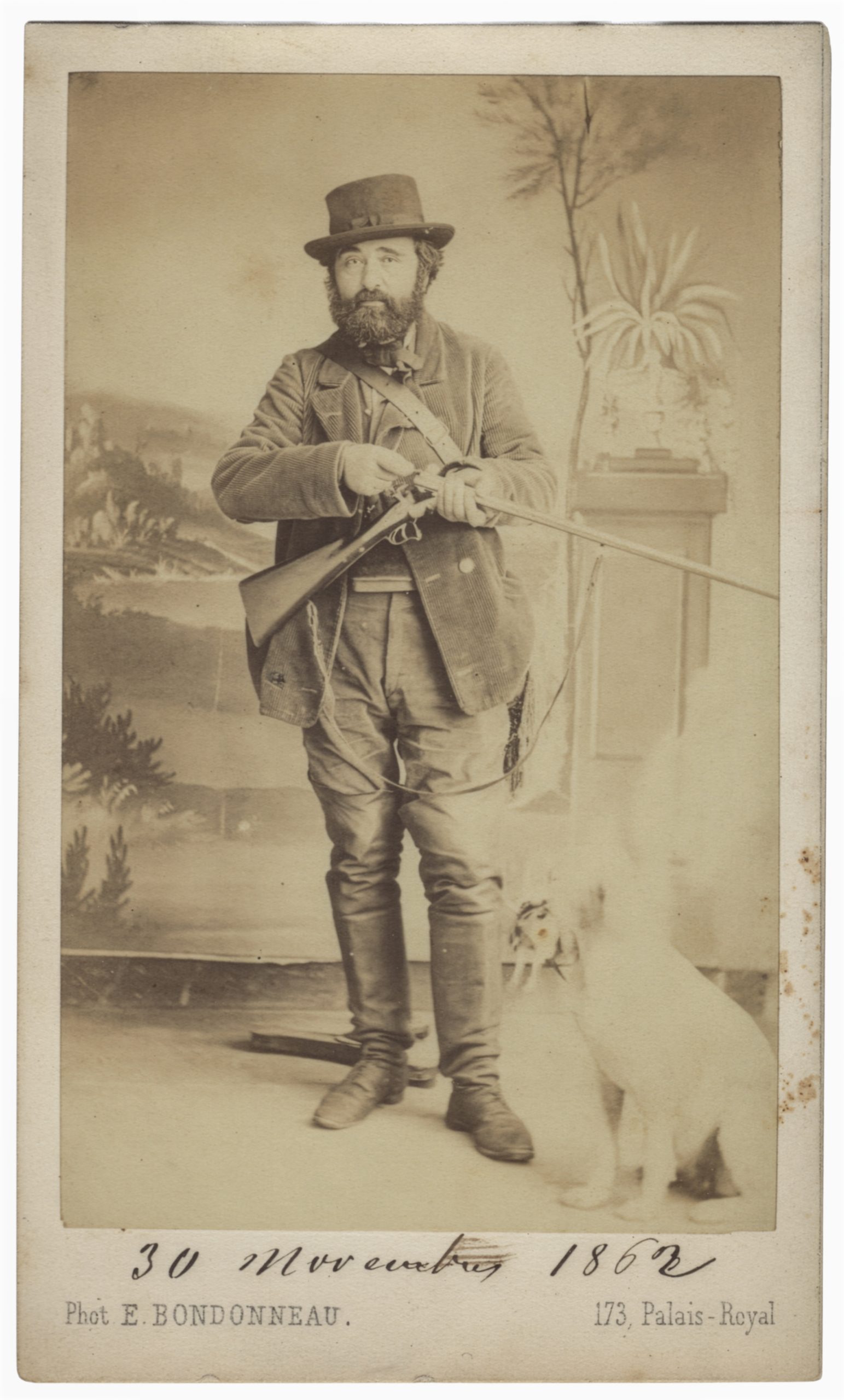
Much writing on firearms history has tended to treat pinfire technology as a transitional step on the way to something else. Seen through that lens, Lefaucheux can appear as a technical chapter rather than a cultural world. Levigne’s painting suggests a different perspective. Here, the pinfire gun is not experimental or unusual. It is present in the field, in use, and visually ordinary. The artist paints it with enough specificity to make it recognizable, but without any need to call attention to it. In other words, the painting records a world in which Lefaucheux was already familiar.
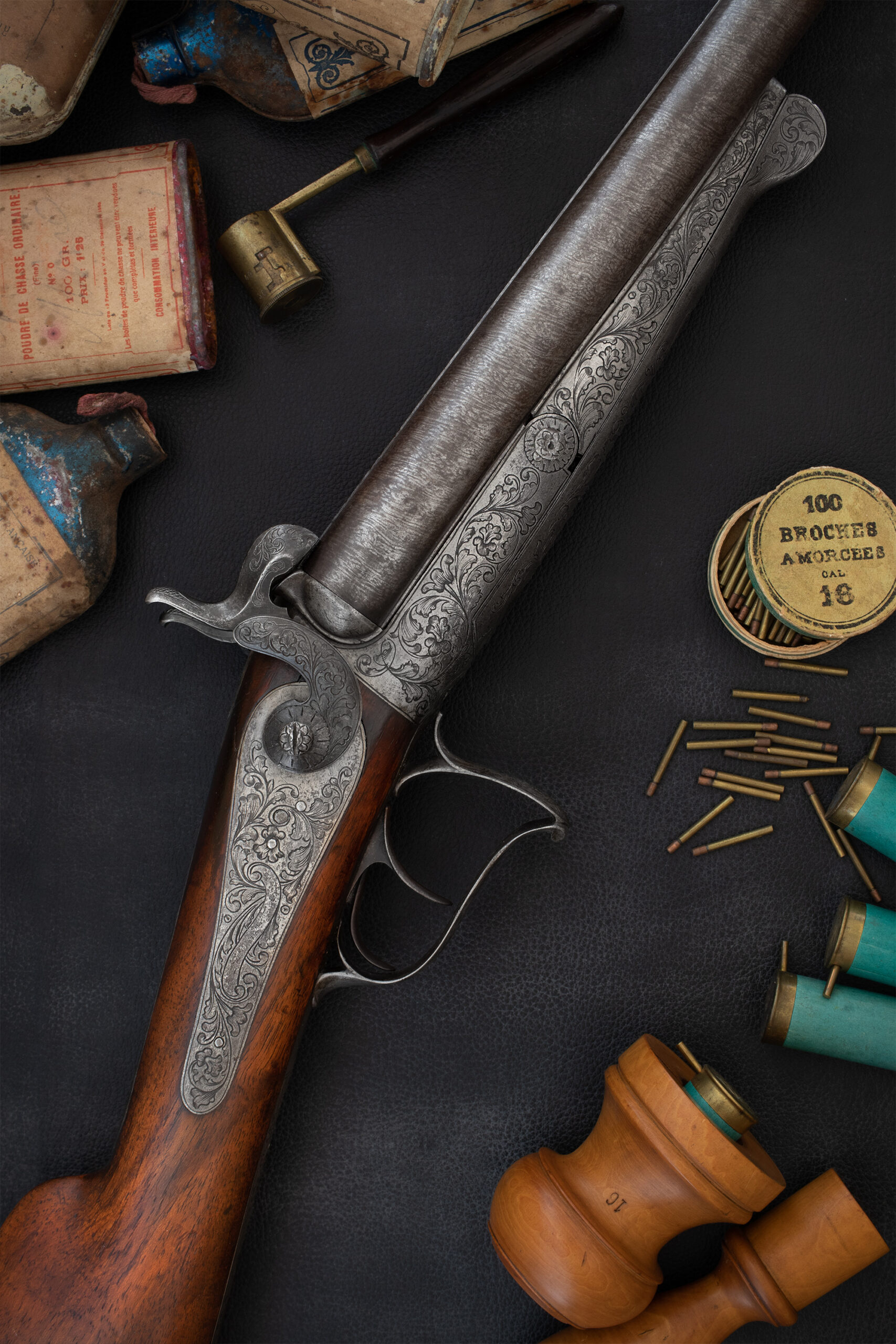
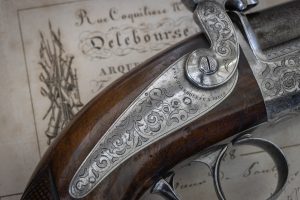
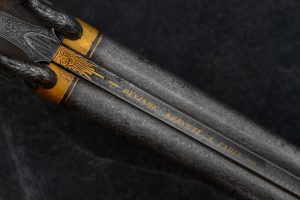
A supporting object photograph helps make this point even clearer. Seen directly, a Lefaucheux sporting gun reveals the elegant shaping of the action, the refinement of its engraving, and the distinctive pinfire cartridges that made the system so recognizable in its own time. Placed beside Levigne’s painted hunter, the object photograph allows the reader to move from visual impression to technical understanding. What seems at first like a simple hunting gun becomes legible as part of a specific firearms system that shaped nineteenth-century sporting life.
The painting also gains strength from its wider social setting. In the background, other hunters appear with long guns of similar general type, even if their exact systems cannot be confirmed at that distance. This is an important nuance. The foreground weapon offers the clearest evidence, while the surrounding figures reinforce the broader setting of shared and widespread use. The result is a layered image of hunting culture. One gun can be identified with confidence. Several others suggest a larger social pattern. Together, they create the impression of a hunting community for whom such arms were standard equipment rather than exceptional possessions.
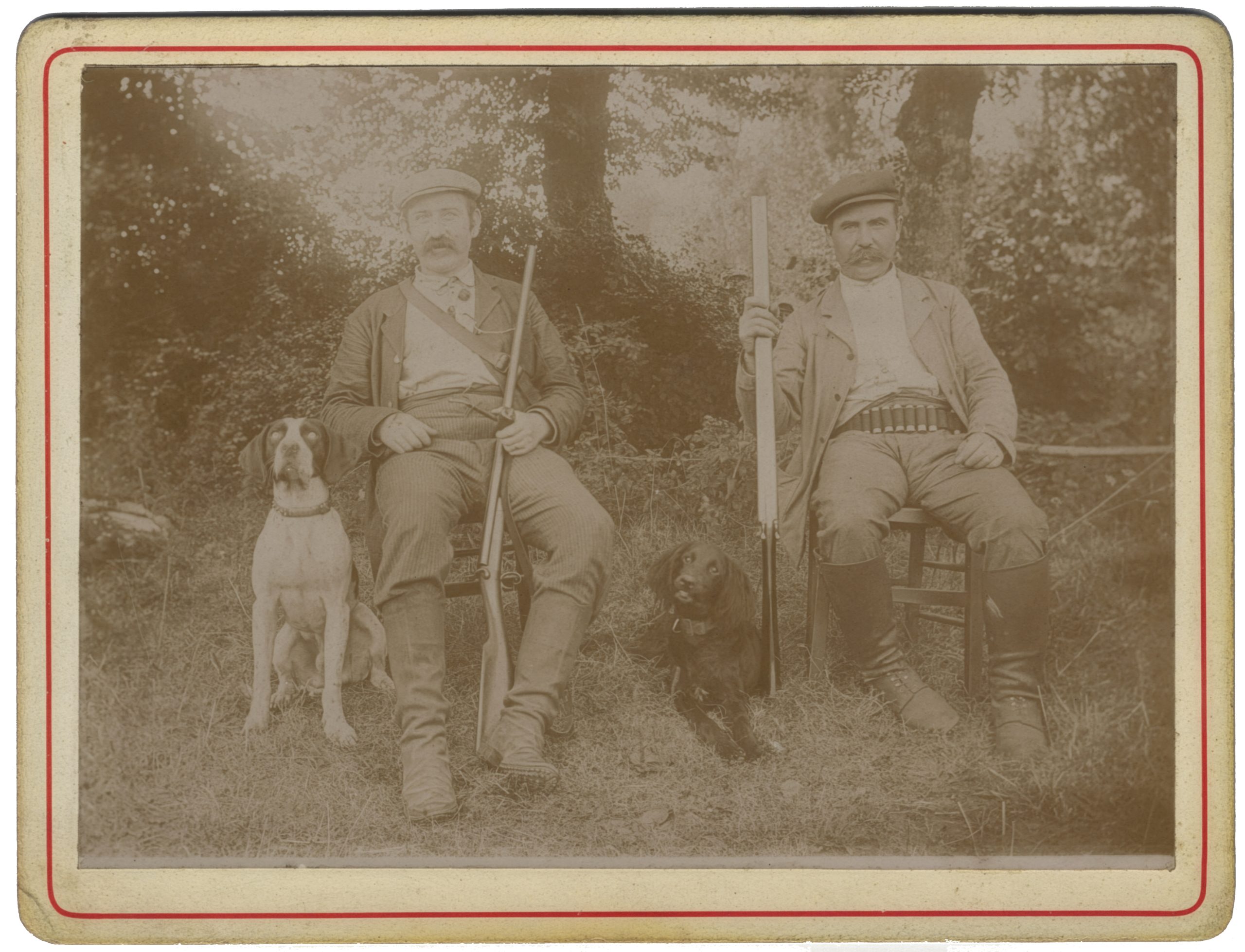
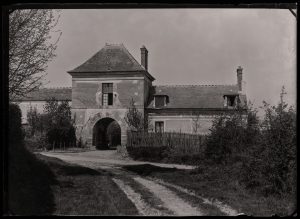
Seen alongside nineteenth-century photographs of hunters with their dogs, Levigne’s scene becomes even more convincing as a record of ordinary life. The relationships between men, guns, dogs, and landscape were part of a coherent sporting world. Paintings and photographs may differ in medium, but together they preserve the same cultural environment. They show that the Lefaucheux gun was not only owned, but carried, rested with, posed with, and integrated into the routines of the field.
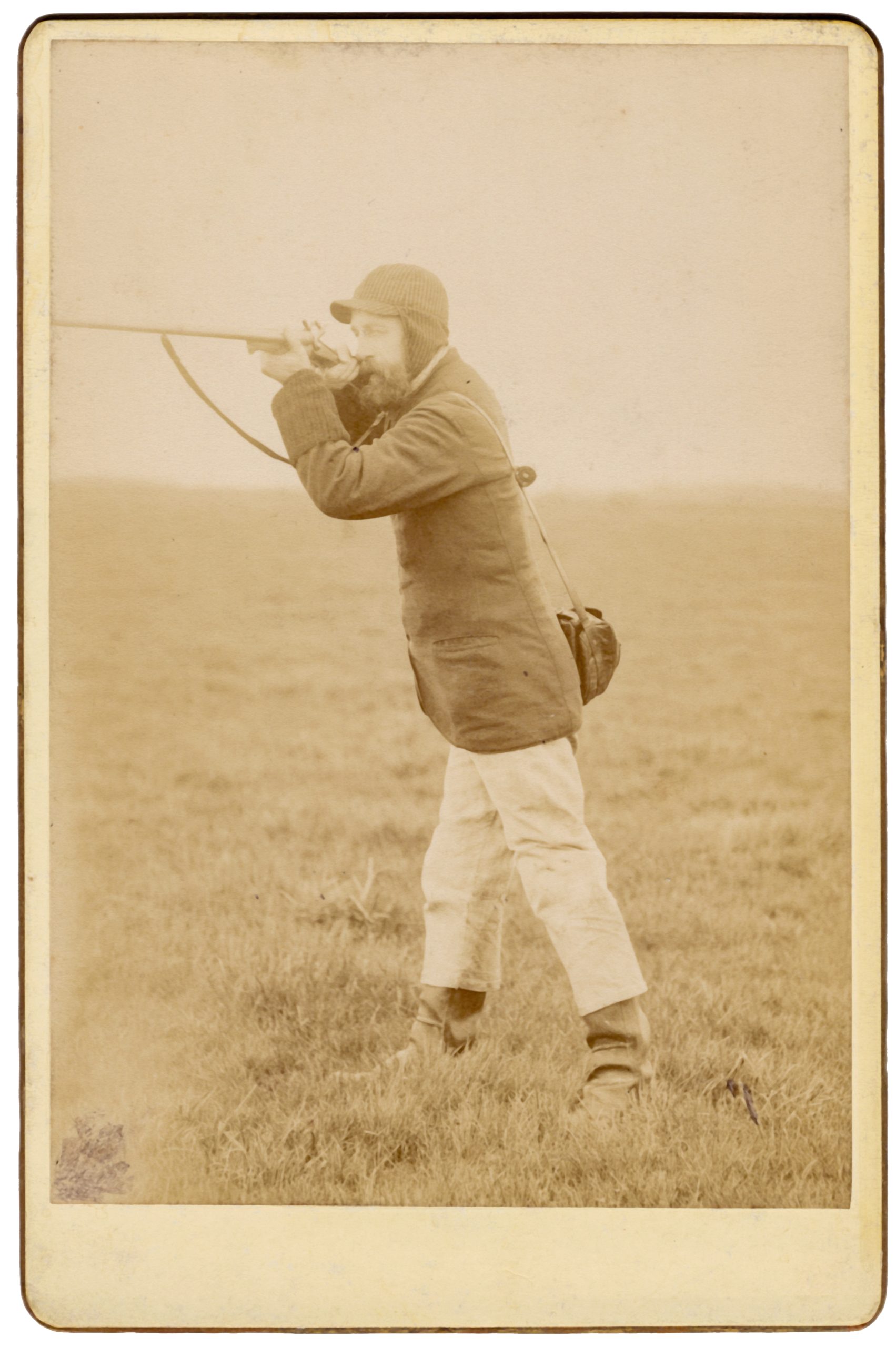
This is why Les chasseurs matters so much for the Lefaucheux Museum. It does not merely show a firearm. It shows a world in which that firearm was already normal. The hunter’s calm posture, the dogs at work, and the presence of other sportsmen in the background all suggest a routine and familiar practice. Levigne was not illustrating a novelty. He was recording a landscape in which Lefaucheux technology had already become part of everyday sporting life.
The painting also reminds us that European firearms history cannot be reduced to later, more mythologized narratives. In popular memory, the nineteenth century is often filtered through an American lens of frontier imagery and revolver iconography. Les chasseurs points to another reality. In rural France, firearms were woven into settled social and sporting traditions. They belonged to the countryside, to hunting practice, and to the rhythms of ordinary life. Levigne’s work preserves that reality with a directness that patent drawings and surviving objects alone cannot fully convey.
As an artwork, Les chasseurs succeeds because it is convincing. As a historical document, it succeeds for the same reason. Levigne was painting a scene his contemporaries would have recognized. The dogs, the dress, the landscape, and the firearm all belong to the same coherent visual world. Nothing suggests fantasy. Everything suggests observation. That is why this painting deserves attention within the story of Lefaucheux. It offers direct visual evidence that pinfire technology had moved beyond workshop innovation and into everyday cultural presence.
For the Lefaucheux Museum, this makes Les chasseurs more than a hunting picture. It is a witness. It shows that the Lefaucheux system was not merely invented, patented, and sold. It was carried across fields, seen by artists, and accepted as part of ordinary European life. Levigne did not set out to write the history of firearms. Yet in painting the world as it was, he preserved a moment in which Lefaucheux was not new, not marginal, and not rare. It was simply there.