

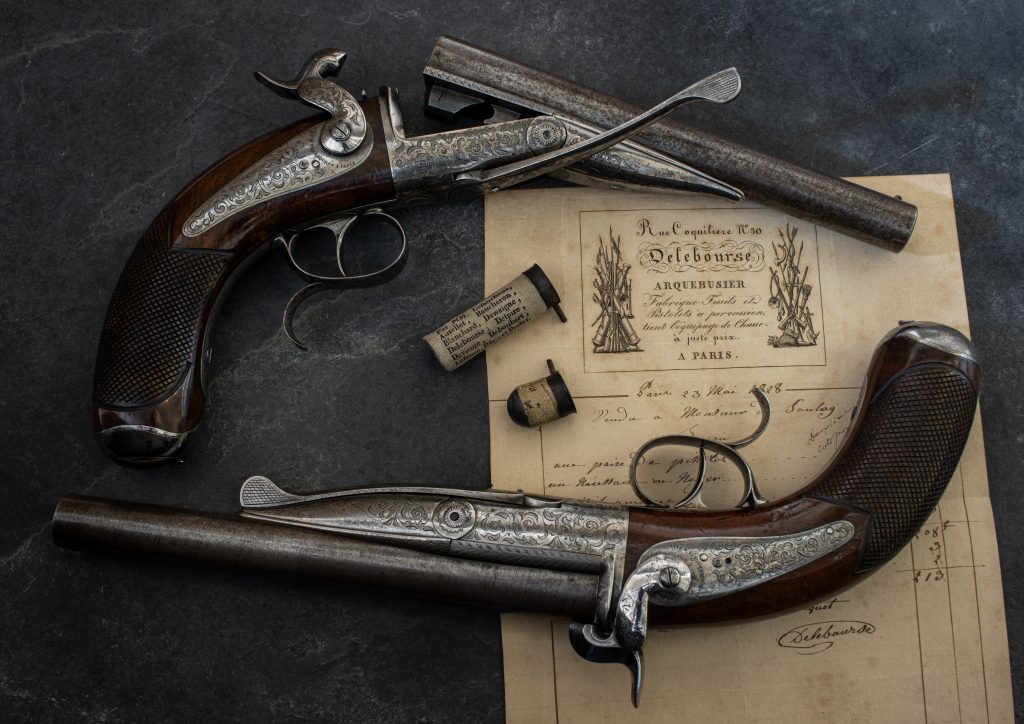
Among the early Parisian names connected to Casimir Lefaucheux, Charles Benoît Victor Delebourse deserves more attention than he usually receives. Delebourse was an experienced gunmaker and innovator before he began handling Lefaucheux arms. By the time Lefaucheux’s hinge-action system began to spread in the 1830s, Delebourse had already spent years working around the technical problems of breechloading arms, percussion ignition, and practical sporting weapons.
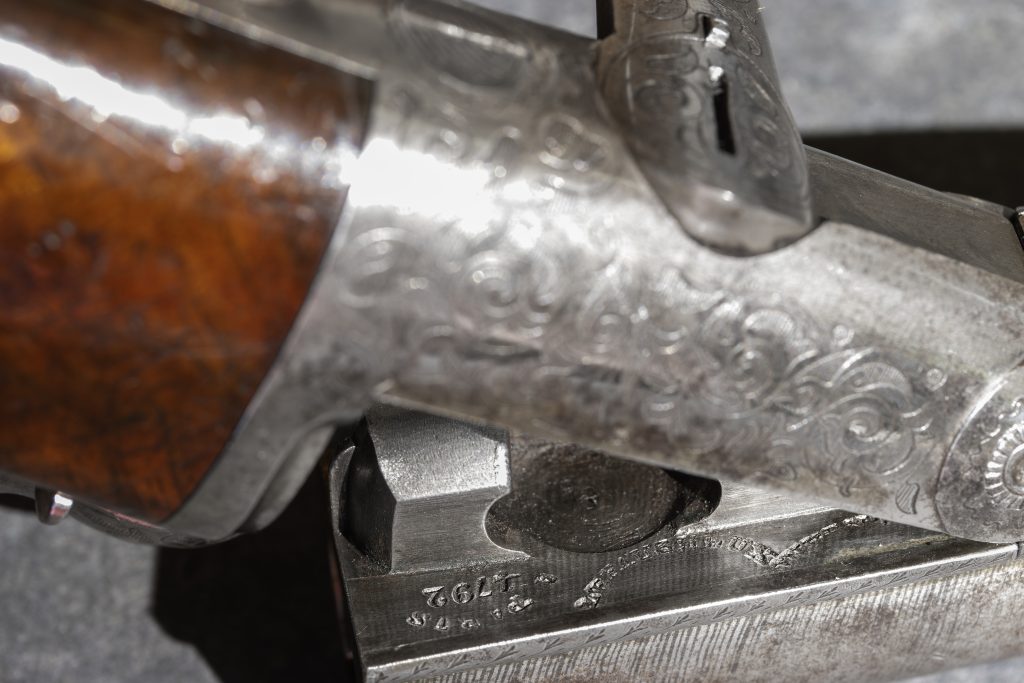
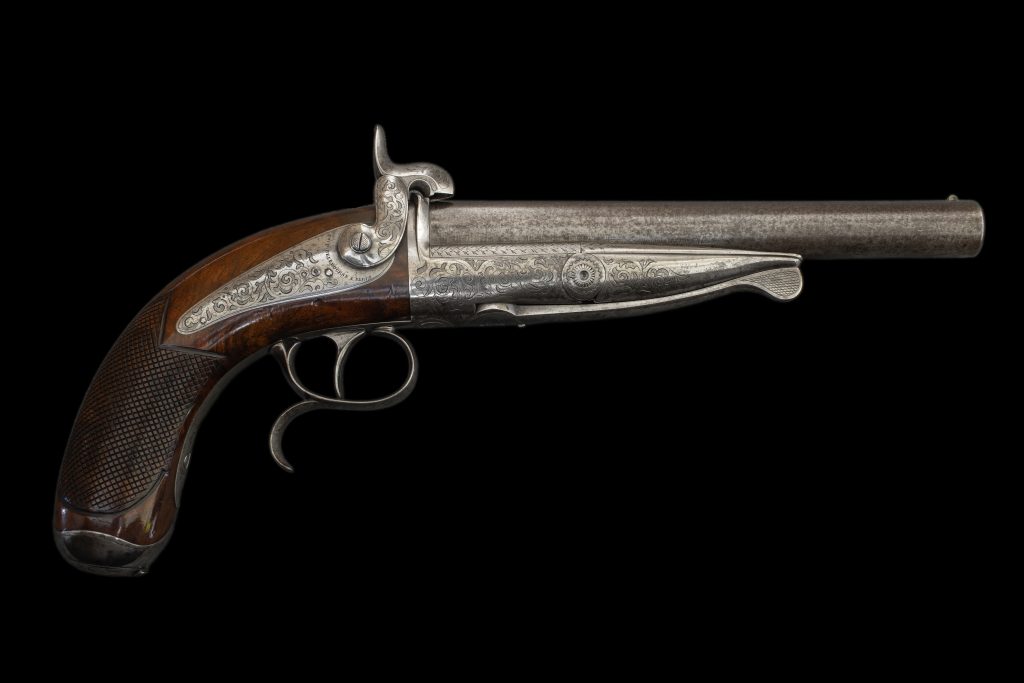
This pair of early pinfire pistols is an important physical link between Delebourse’s paper trail and the early commercial life of the Lefaucheux system. The pistols are compact break-action arms with external hammers, folding trigger guards, rounded checkered walnut grips, and fine scroll engraving across the locks, hammers, breech sections, levers, trigger guards, and butt caps. Both pistols carry the matching serial number 1792, confirming them as a true pair.
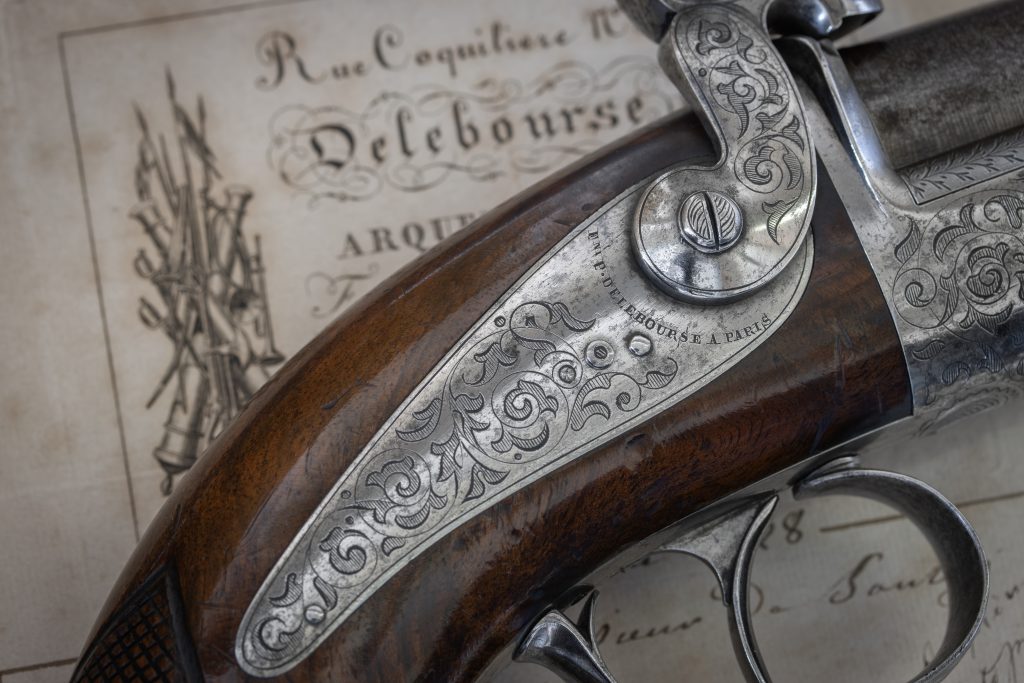
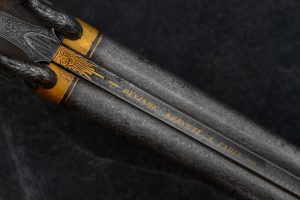
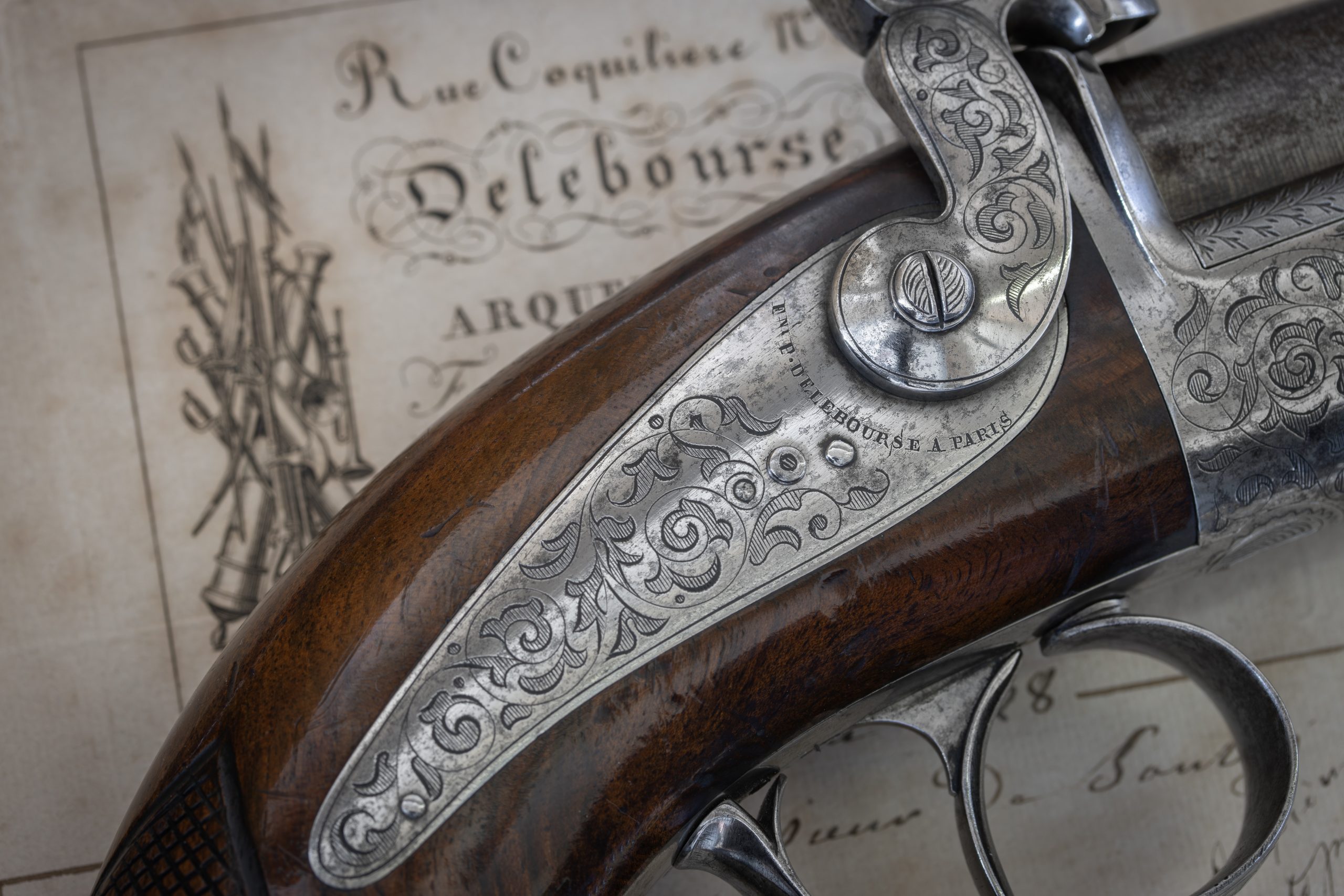
Beneath the barrels, each pistol bears the half-oval “Invention Lefaucheux Paris” mark, placing the pair within the licensed world of early Lefaucheux arms. The lock area is marked “Fni P. Delebourse à Paris,” meaning finished by Delebourse in Paris. Together, the markings identify both the patented Lefaucheux system and the Paris shop that completed and sold the pair.
The pistols date from the late 1830s or early 1840s, shortly after Delebourse became one of Lefaucheux’s original Paris concessionaires.
Delebourse before Lefaucheux
Delebourse was already active in Paris by the early 1820s. In 1827, a newspaper report discussing Pauly-system guns noted that Cessier had greatly perfected the Pauly guns and that Delebourse had made important modifications to them. The following year, on 16 June 1828, Delebourse patented improvements to the Pauly system.
His 1828 patent addressed several practical weaknesses. He sought to protect the lock mechanism from smoke, fouling, and oxidation, moved the percussion nipples closer to the cartridge, and attempted to direct the ignition flame more efficiently into the charge. These changes were practical attempts to make breechloading arms cleaner, faster, and more reliable.
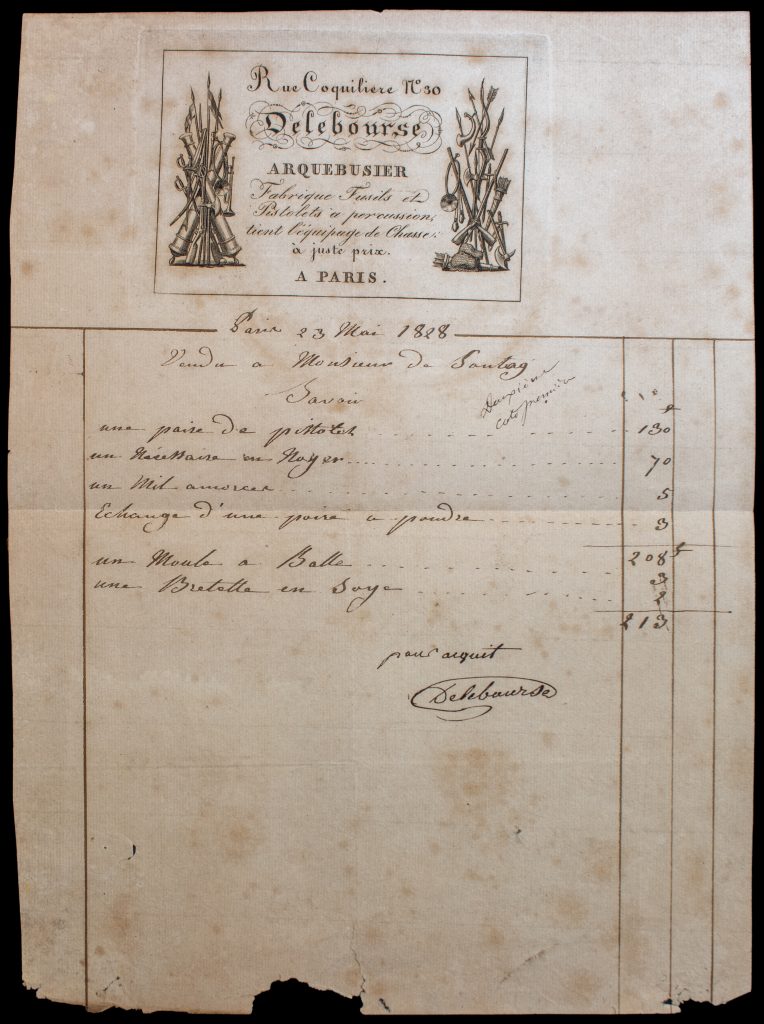
A newly found invoice from Delebourse’s shop adds an important commercial detail. Dated 23 May 1828, the billhead places him at 30 rue Coquillière and identifies him as an arquebusier selling fusils, pistolets, poires à poudre, and équipages de chasse. The handwritten bill records the sale of a pair of pistols, a case or nécessaire, a powder flask exchange, a bullet mold, a sling or strap, and “un mil amorces,” one thousand primers or percussion caps.
The invoice places Delebourse in the same technical world from which the Lefaucheux system soon emerged: pistols, percussion ignition, sporting arms, and the search for a practical breechloading gun.
The Lefaucheux connection
Delebourse’s later association with Lefaucheux makes sense in this context. He had already been working on the same broad problem of how to make breechloading sporting arms practical.
On 31 May 1833, Delebourse joined Baucheron, Lefaure, Deboubert, and Prelat among the original Paris concessionaires of Lefaucheux’s hinge-action gun. The agreement bound them to share the costs of pursuing counterfeits of the “fusil dit à charnière,” placing Delebourse in the first organized group working to protect and commercialize Lefaucheux’s invention.
His 1835 testimonial reinforces that role. In it, Delebourse explained that he had long followed breechloading arms and had introduced improvements himself, but that the desired practical result was only achieved with the appearance of Lefaucheux’s hinge-action gun. He stated that he was among the first to negotiate with Lefaucheux for the right to manufacture the system, and that he had since made and sold such arms with satisfactory results.
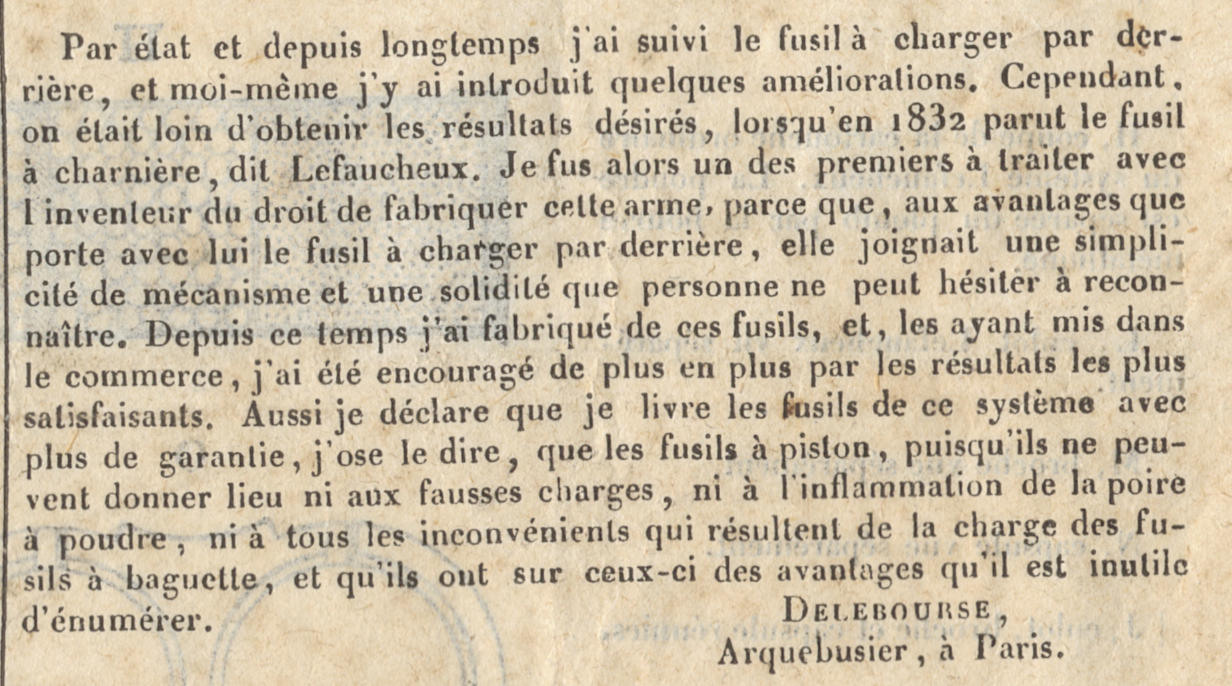
That testimonial is important when viewing this pair of pistols. Rather than being isolated objects with a retailer’s name, these pistols form part of the documented relationship between Delebourse and Lefaucheux.
The pistols
The pair shown here reflects an early stage of Lefaucheux-system pistol development. In profile, the pistols show the compact proportions of early personal pinfire arms: long round barrels, rifled bores, rounded walnut grips, external hammers, and folding trigger guards. When opened, the barrels pivot forward from the standing breech, exposing the chamber for loading in the Lefaucheux manner. Each grip also ends in a metal butt cap with a hinged trap, forming a small compartment in the base of the handle for cartridges, ammunition components, or other small accessories.
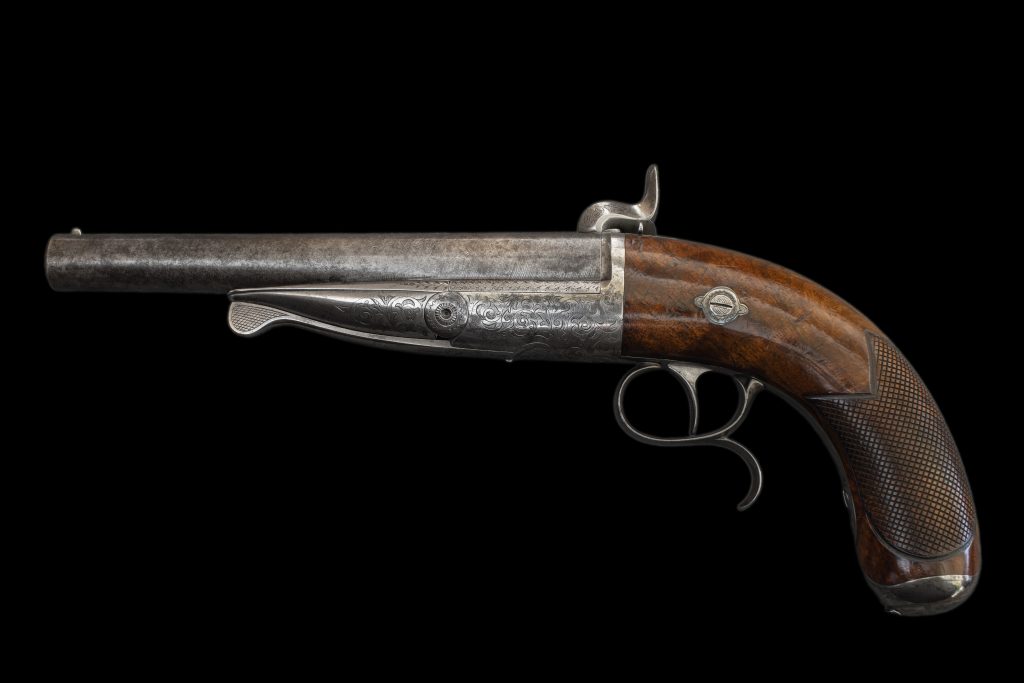
The decoration is restrained and elegant, with fine scroll engraving across the lockplates, hammers, breech sections, opening levers, trigger guards, butt caps, and small furniture. The checkering on the walnut grips is neatly cut and follows the curve of the handle, while the engraved metalwork frames the working parts of the pistol. The result is a pair that feels technical and refined at the same time, with the ornament drawing attention to the action, the opening lever, and the signed lockplate.
For Delebourse, these pistols represent a natural progression. In the 1820s he was connected to Pauly-system breechloading improvements. In 1828 he was selling pistols and percussion primers. In 1833 he entered the Lefaucheux concession network. By the late 1830s, arms such as this pair show how that network became real objects in the hands of customers. They survive as a rare signed trace of that early licensed trade.