

At the beginning of 1813, Jean Samuel Pauly stood at the uncertain point between invention and manufacture. His breechloading arms had been examined by the French military, and he had secured a patent for his system on September 29, 1812. Military adoption had not followed. In February, he informed the minister of war that necessity would soon compel him to offer rifles and pistols of his manufacture directly to the public.
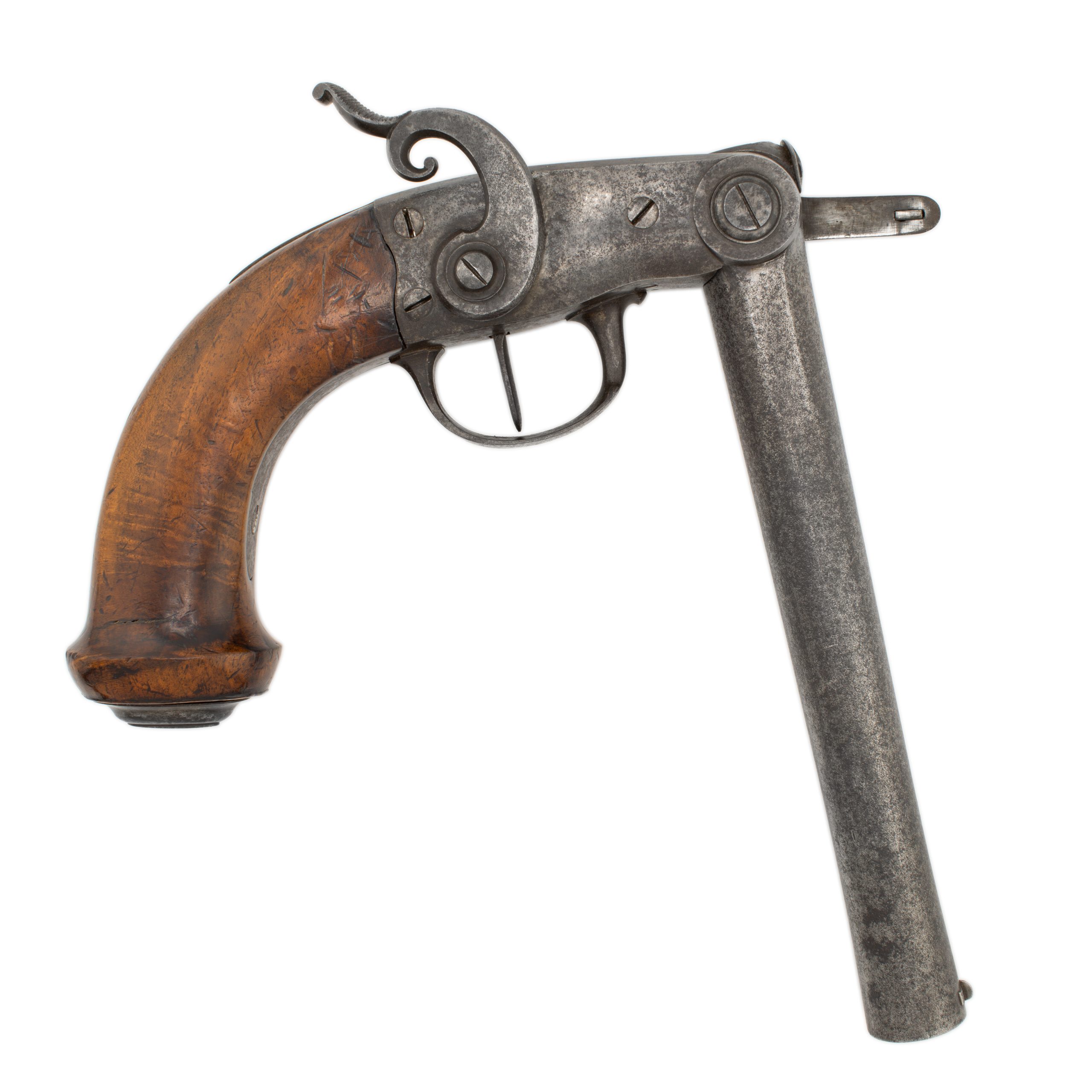
This pistol belongs to that moment. It was made as Pauly’s cartridge system was moving out of official trials and into early numbered production, while important details of the firearm were still being worked out in the workshop.
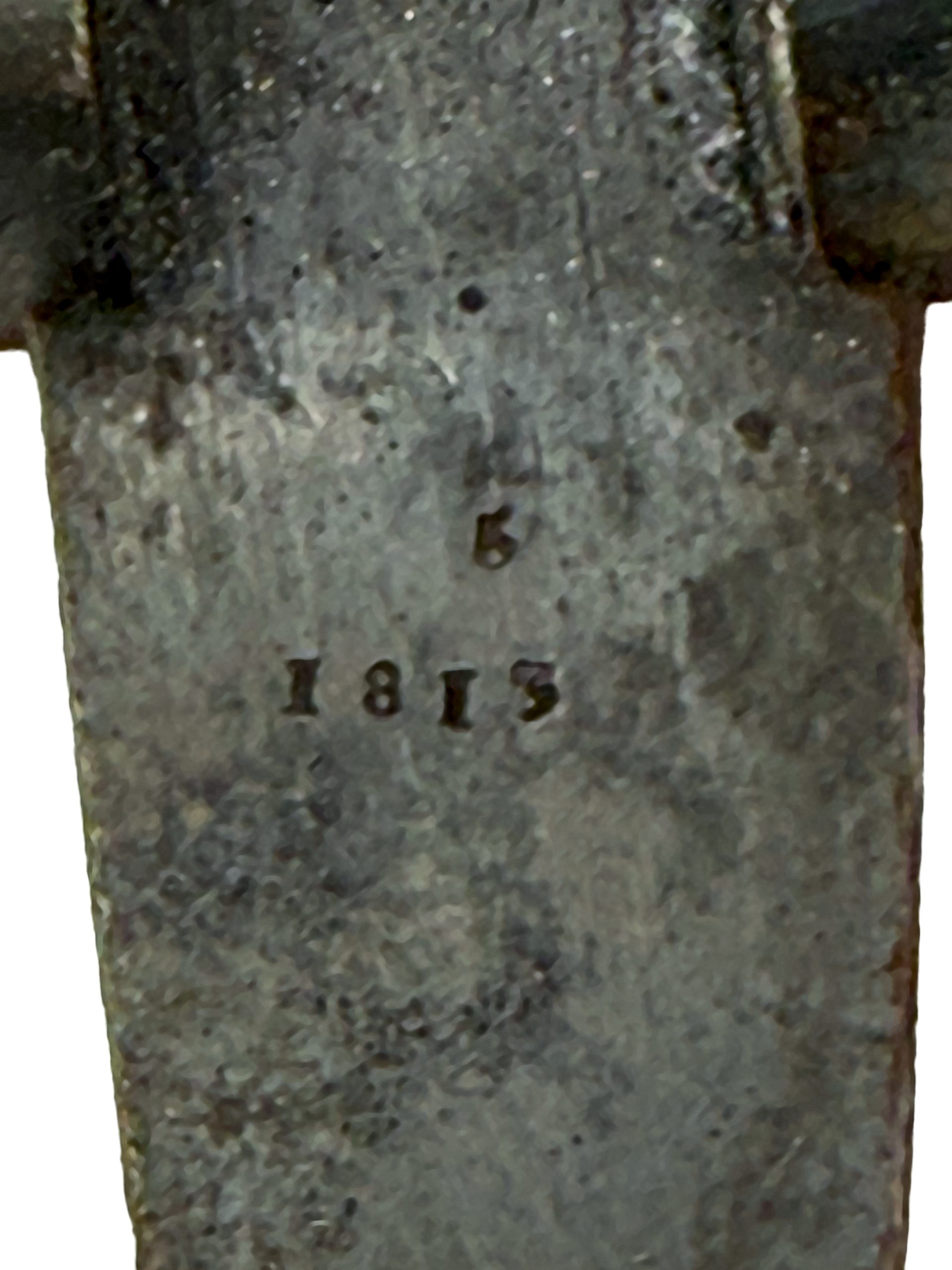
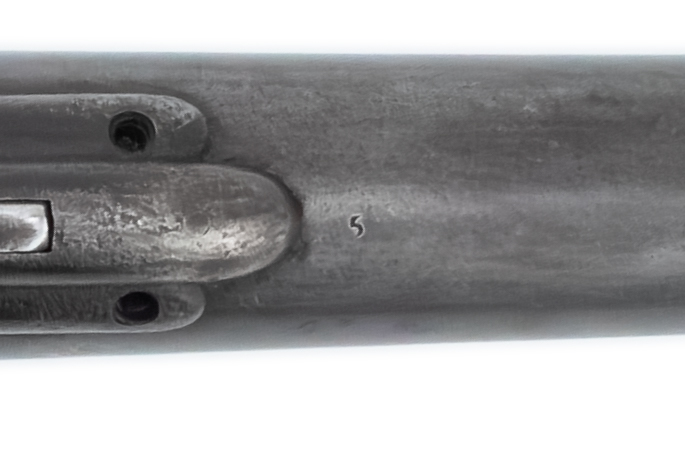
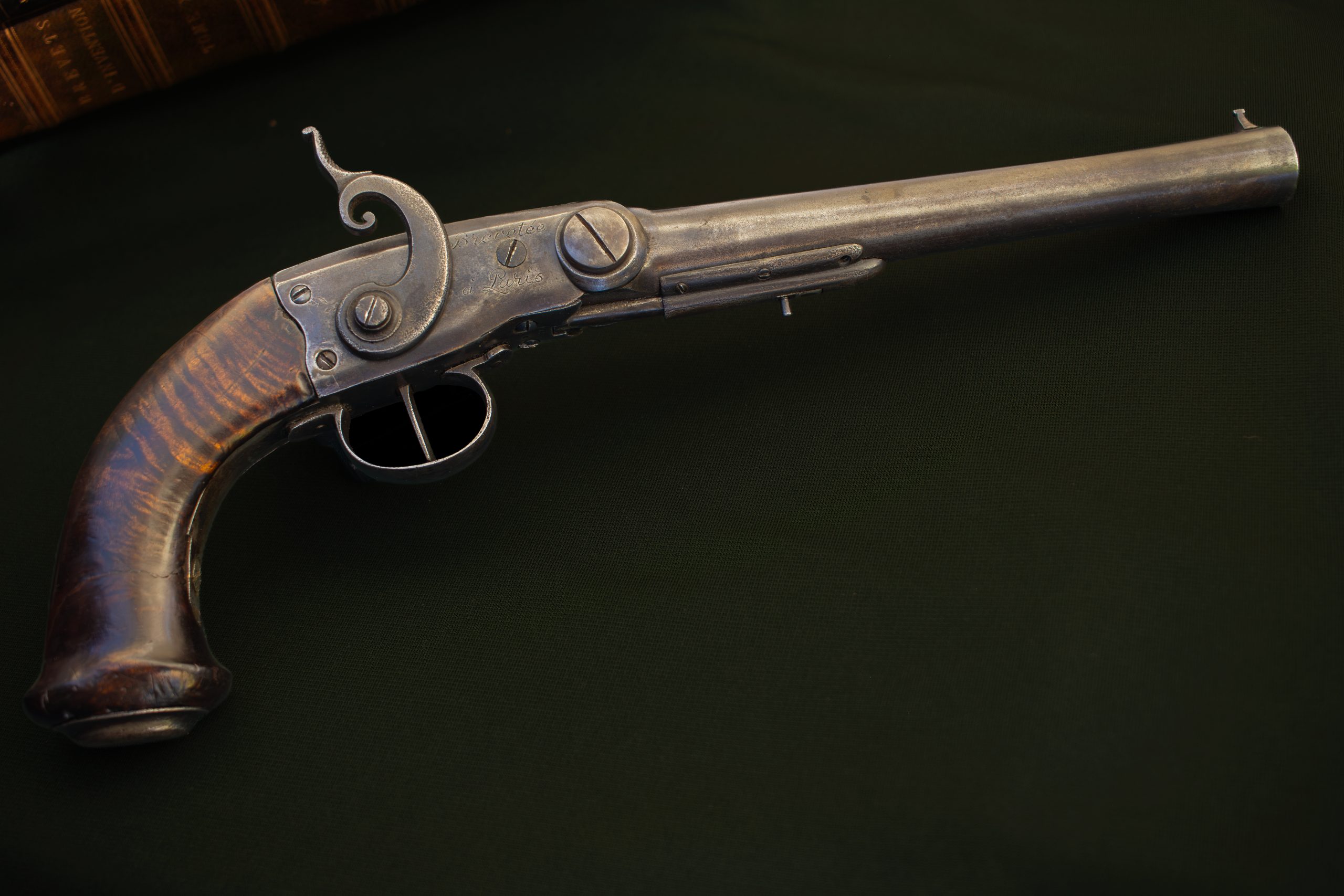
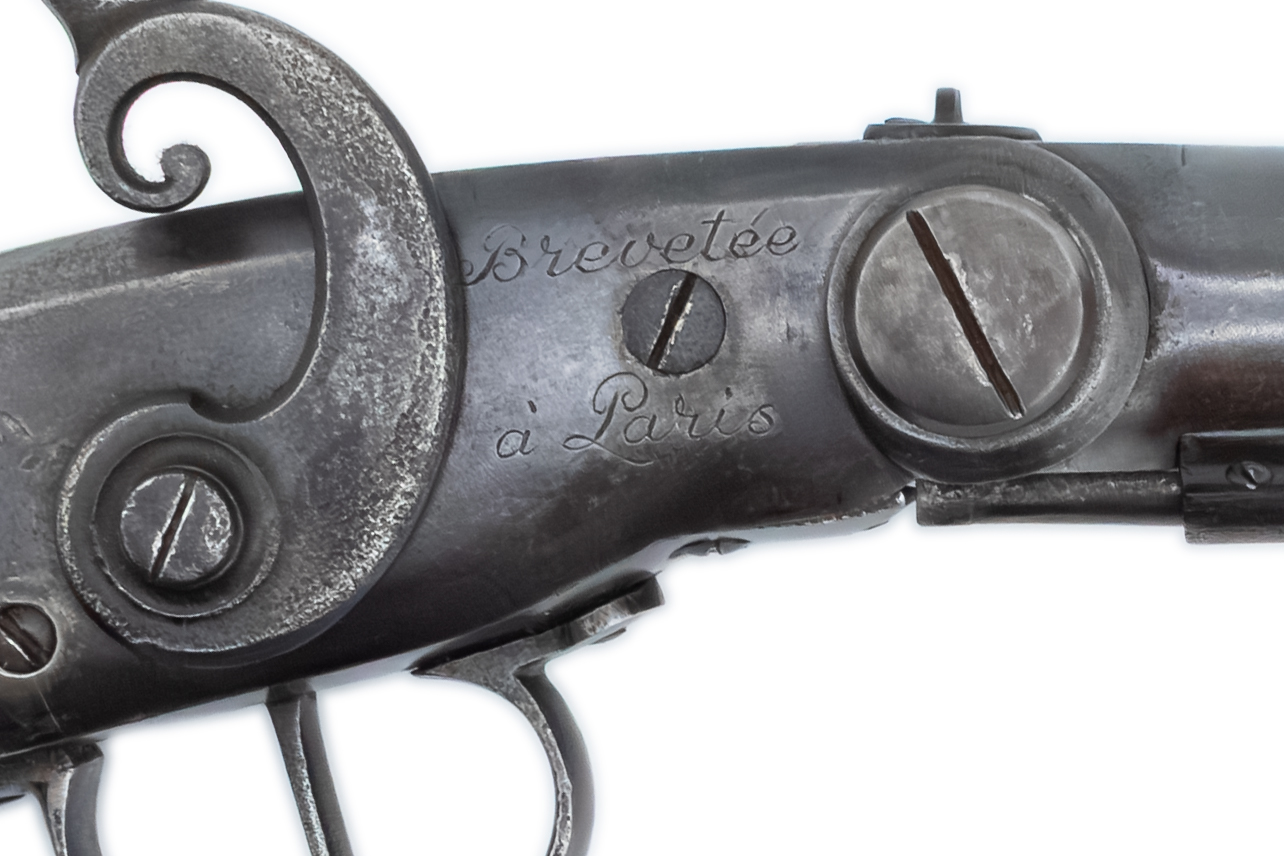
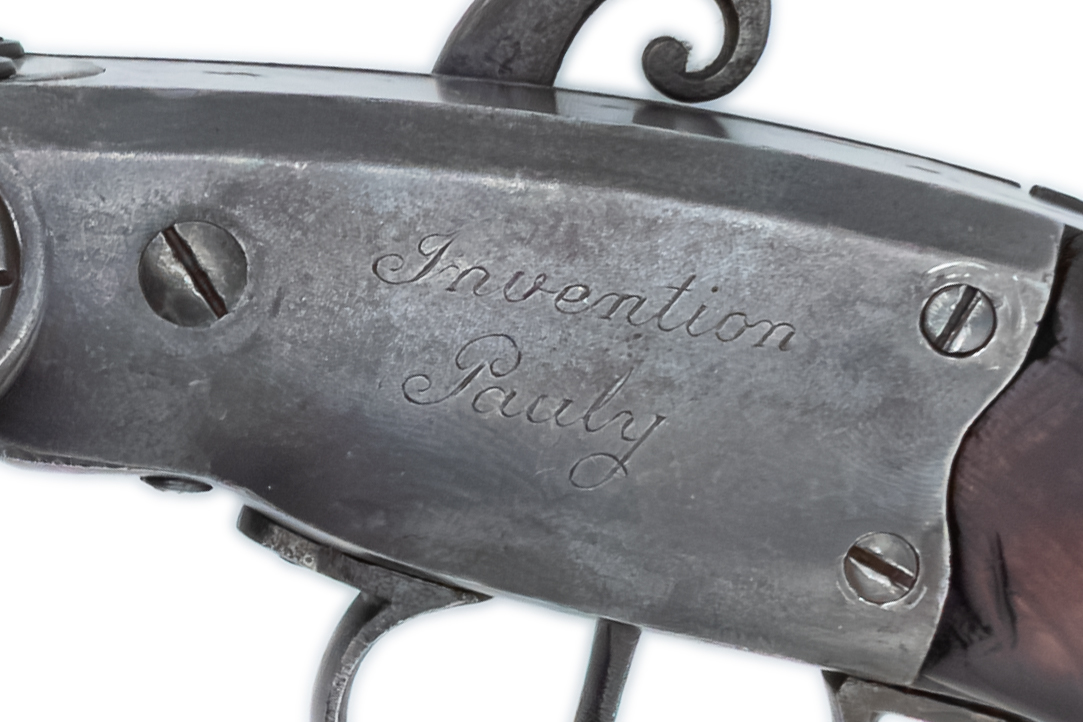
From the outside, its identity is unmistakable. The barrel carries the gold-inlaid inscription INVon PAULY, while the frame is signed Invention Pauly and Breveté à Paris. Its most revealing markings, however, are hidden inside. An internal surface of the frame is stamped with a small 5 above the date 1813. A second 5, more discreetly placed beneath the barrel, identifies the barrel and frame as fitted components of the same arm.
This is Pauly pistol No. 5, made in 1813.
The date places the pistol within months of Jean Samuel Pauly’s French patent of September 29, 1812,¹ and in the same year that he announced his intention to begin selling rifles and pistols of his manufacture to the public. Its construction is equally revealing. Beneath the barrel is a sliding lock that is not explained in Pauly’s original patent and that I have not encountered on any other Pauly pistol.
What Made Pauly’s Cartridge Modern
The word cartridge was already familiar in 1813, but it usually meant something quite different from what it means today. A military paper cartridge packaged a measured powder charge and ball for convenience. The shooter tore it open, poured the powder down the muzzle, and then loaded the ball and paper. Ignition remained a separate operation performed by the gun’s lock, generally with loose priming powder in an exposed pan.
Earlier inventors had also produced many forms of breechloading firearm. Some used removable chambers or preloaded blocks, and others placed prepared charges into the rear of the barrel. These systems made loading from the breech possible, but they did not unite the ammunition and its ignition into one complete unit.
Pauly’s cartridge did.
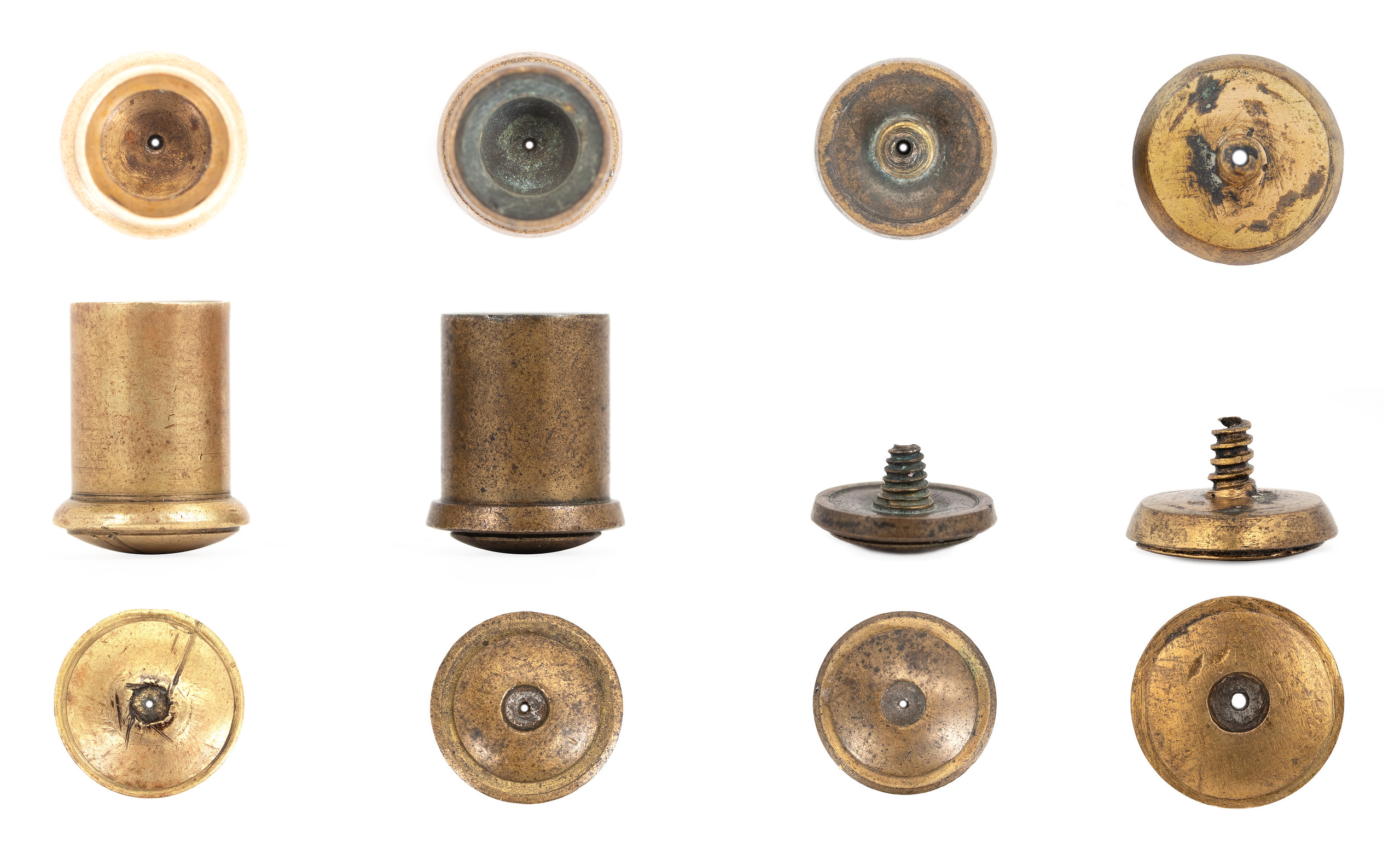
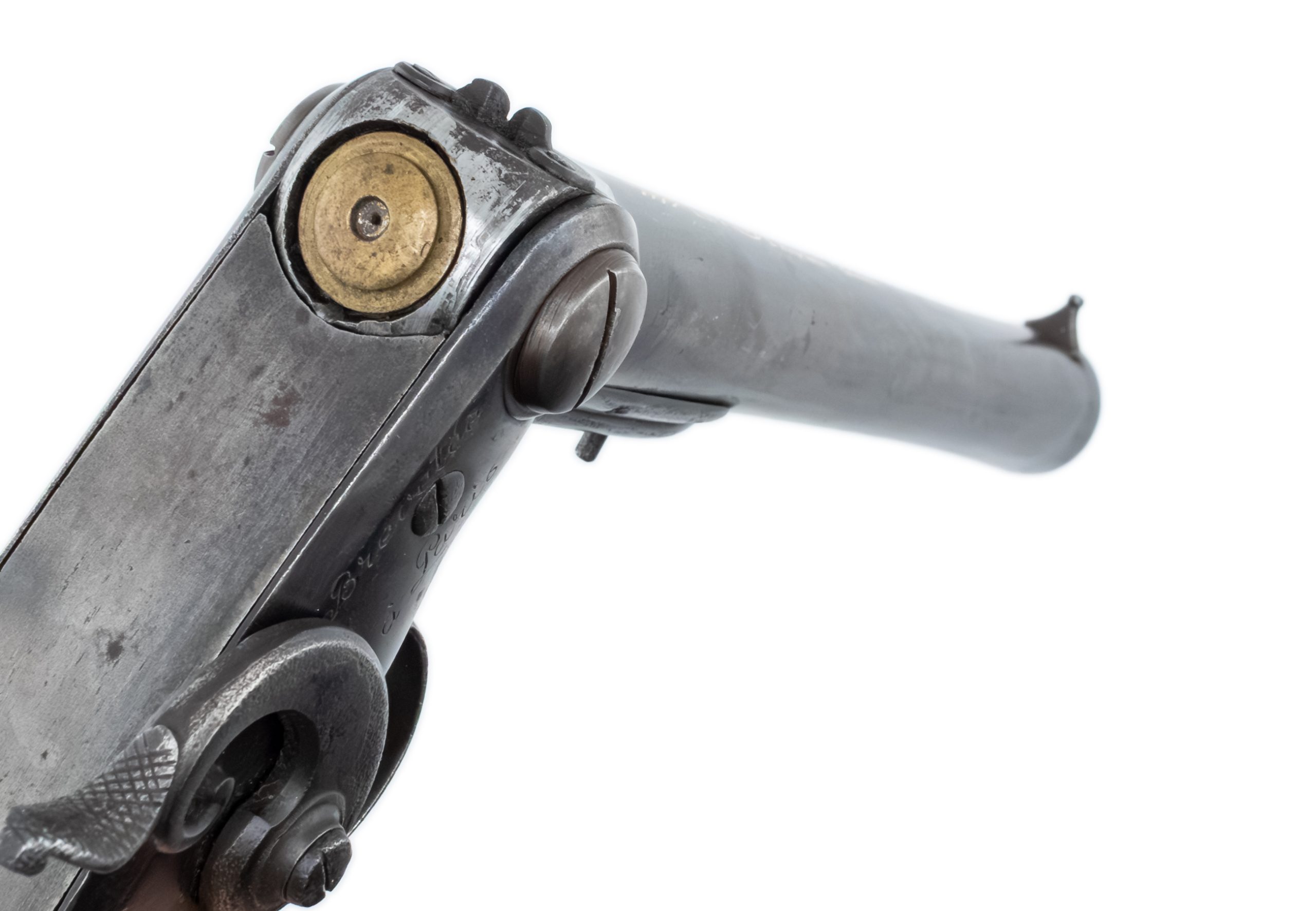
His ammunition brought together the projectile, propellant, and primer in a cartridge loaded intact into the breech. A metal base carried the priming composition, formed part of the closure at the rear of the chamber, and presented the primer to a piston or striker inside the firearm. When the trigger was pulled, the piston struck the primer at the rear of the cartridge and communicated fire directly to the main charge.
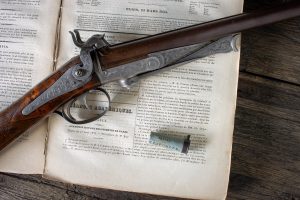
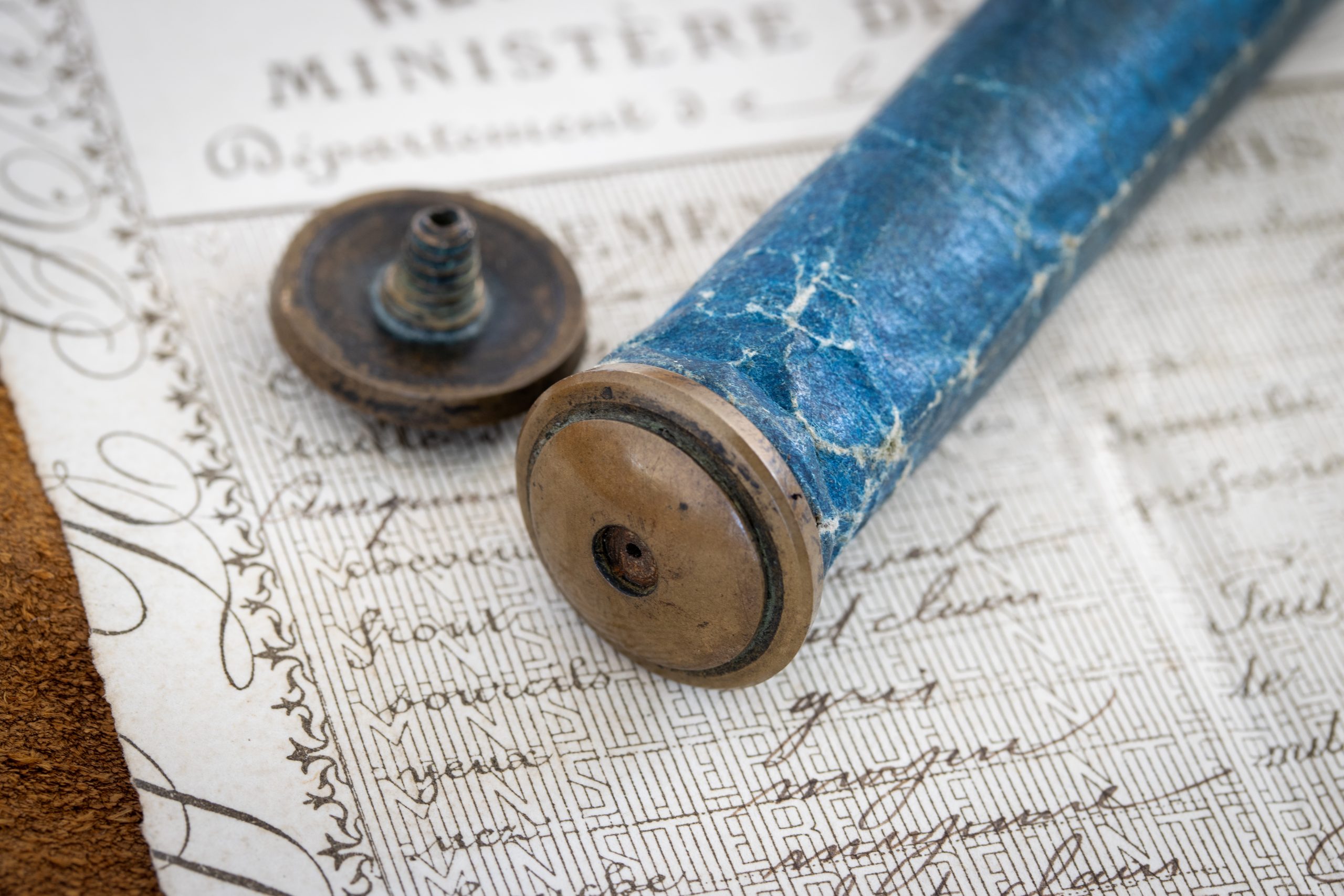
Pauly and his successors used more than one cartridge construction, producing components in both copper and brass. A paper body could be attached to a metal base or threaded rosette that was recovered and reused. Pistols could also employ a deeper metal cartridge cup containing the powder, with the ball pressed into its mouth. These cartridges differed considerably in appearance and construction from the drawn brass cases that later became standard. Their importance lies instead in the relationship they established between the ammunition and the firearm. The projectile, propellant, and primer traveled together as one unit, entered the gun through the breech, and were fired mechanically from behind.
The result was a firearm and its ammunition designed as a single system.
From Military Trials to the Public Market
Pauly first pursued his invention as a military arm. In the spring of 1812, the French war ministry ordered an examination of his firearm, and a military commission began evaluating it.² The surviving reports concentrate on his rifle and describe its construction, cartridge, protected ignition, rapid loading, and performance. They also record objections concerning cost, complexity, the skill required to manufacture and repair it, and the handling of its cartridges and priming composition.
While these trials were underway, Pauly secured a ten-year French patent on September 29, 1812. His application covered military and sporting guns, a new pistol, and cartridges made specifically for those arms.³ The pistol was part of the patented system from the beginning.
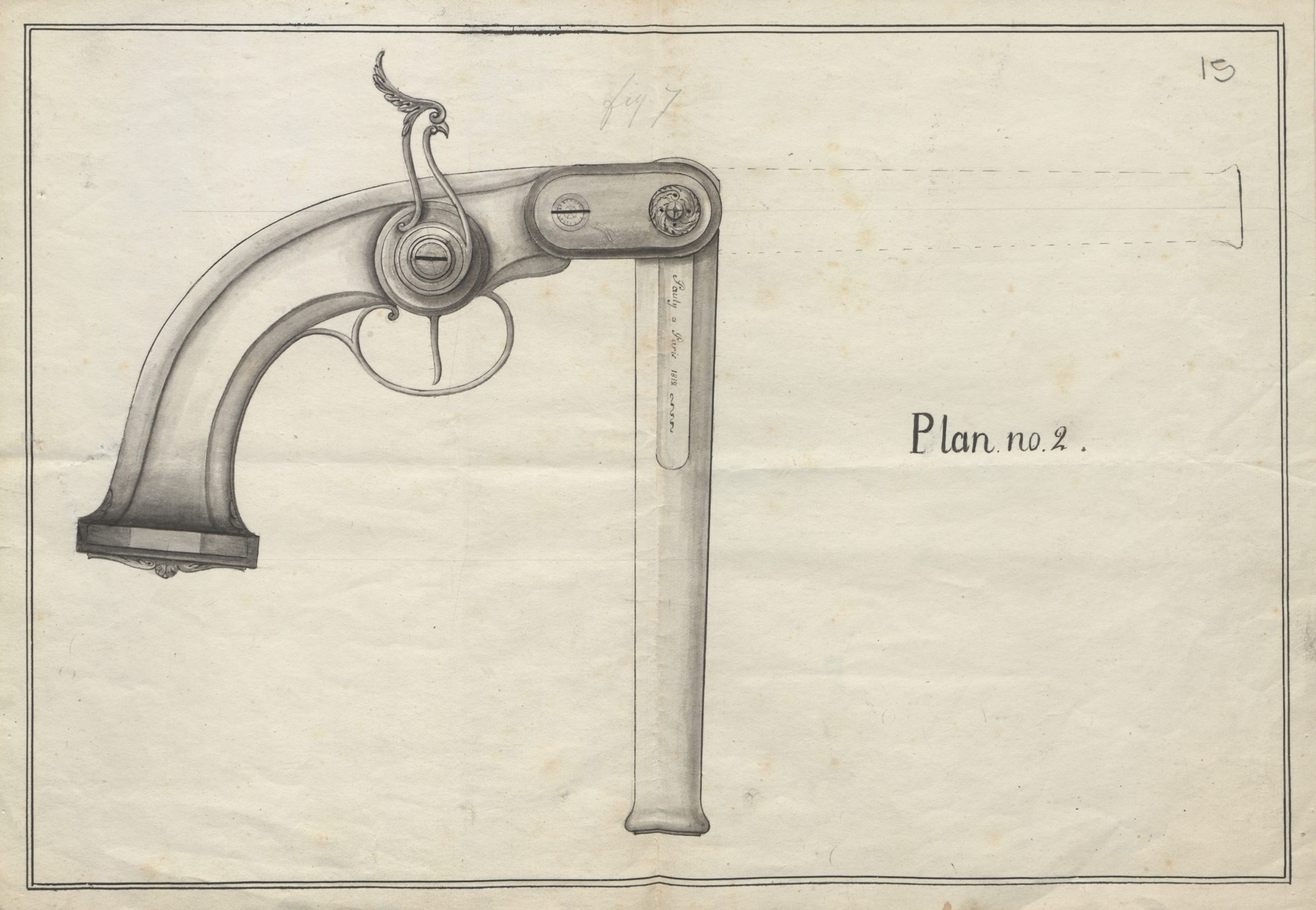
Publicity for Pauly’s system was already creating commercial interest before the military examination had concluded. In September 1812, the Bulletin de la Société d’encouragement pour l’industrie nationale published a notice on his new firearms together with Baron Delessert’s report. It described Pauly’s military and sporting guns, his pistol, and the specially prepared cartridge that introduced the charge and primer together through the breech. Delessert explained that Pauly had asked him to present the system to the Society as the surest means of making it known.⁴
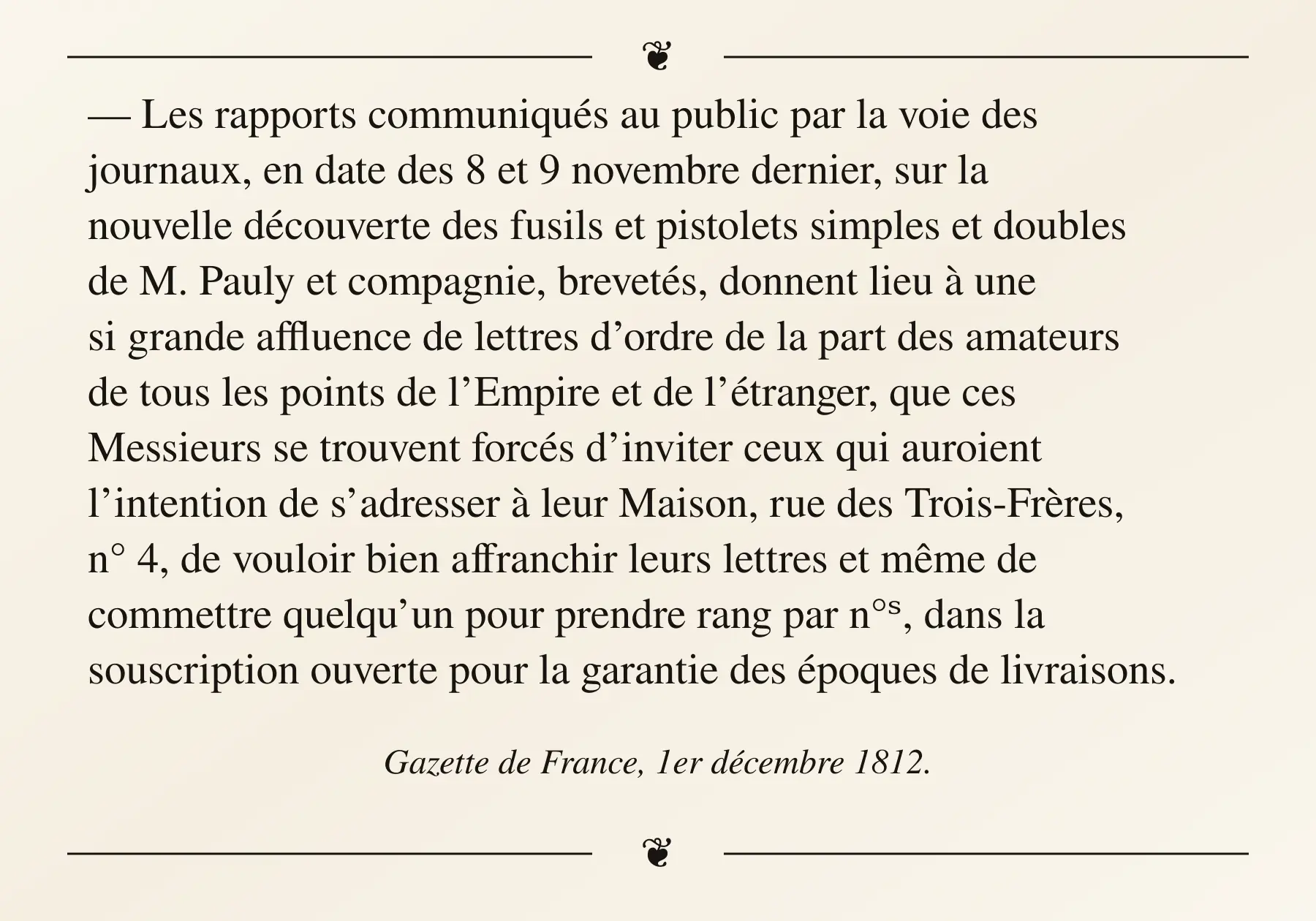
Newspapers began circulating the Society’s account in early November. A notice published in the Gazette de France on December 1 referred specifically to reports dated November 8 and 9 and stated that the resulting publicity had produced an influx of orders from enthusiasts throughout the Empire and abroad. Prospective customers were asked to take numbered places in an open subscription so that delivery dates could be established.⁵
This public interest did not alter the military decision. The commission issued its final report on December 9, 1812. Although its examination had centered on Pauly’s rifle, he had also submitted a military pistol. The commissioners acknowledged that the pistol operated on the same principle and shared the rifle’s principal advantages. They nevertheless objected to its priming composition, reusable copper bases, expense, heavy trigger pull, and recoil, and recommended against adopting either firearm for military service.⁶
The treatment of the two arms was noticeably uneven. The report records extensive examination and firing of the rifle, then disposes of the pistol in a short concluding passage. It gives no separate pistol trial, no firing results, and no detailed examination of its mechanism.
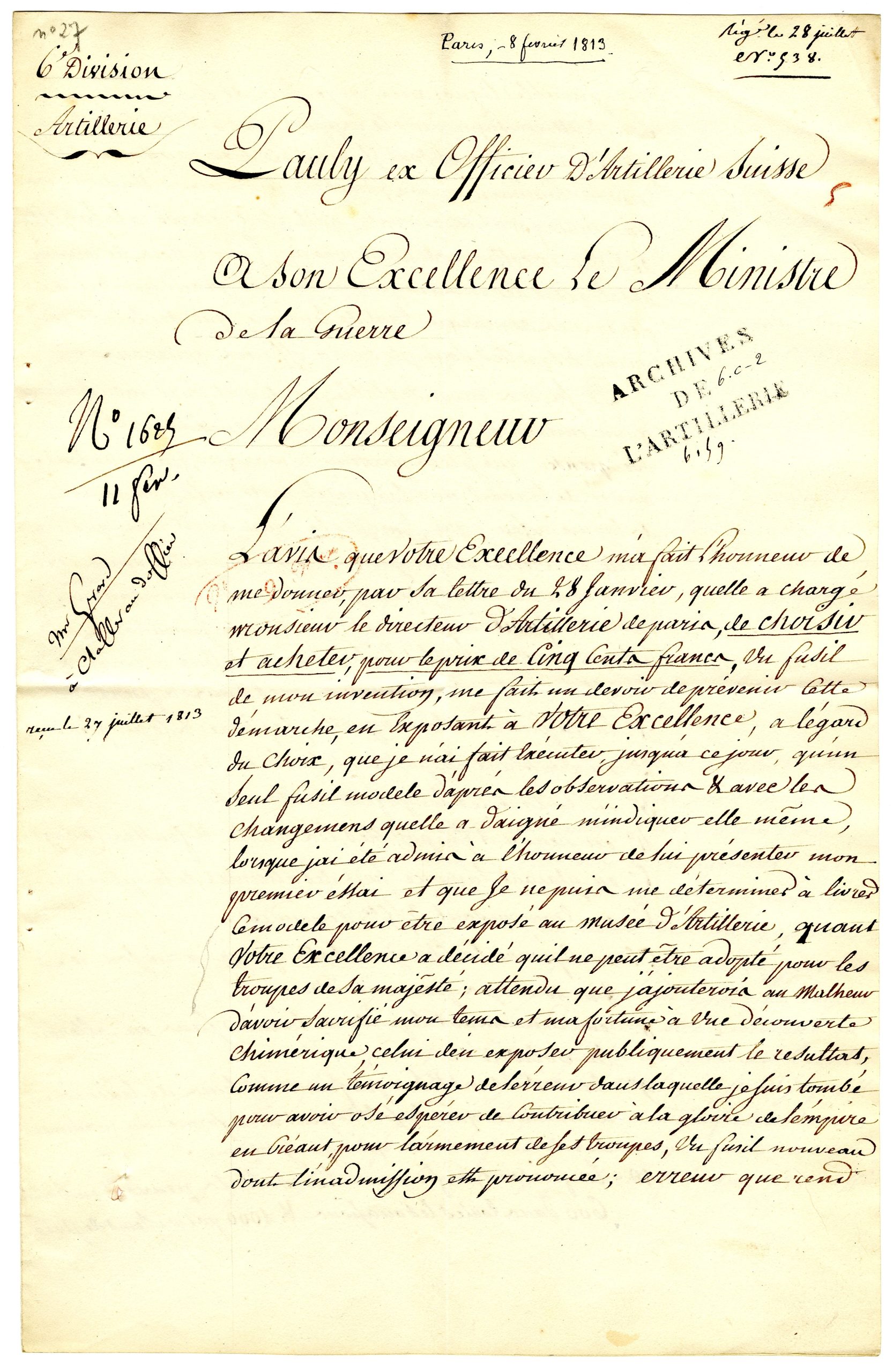
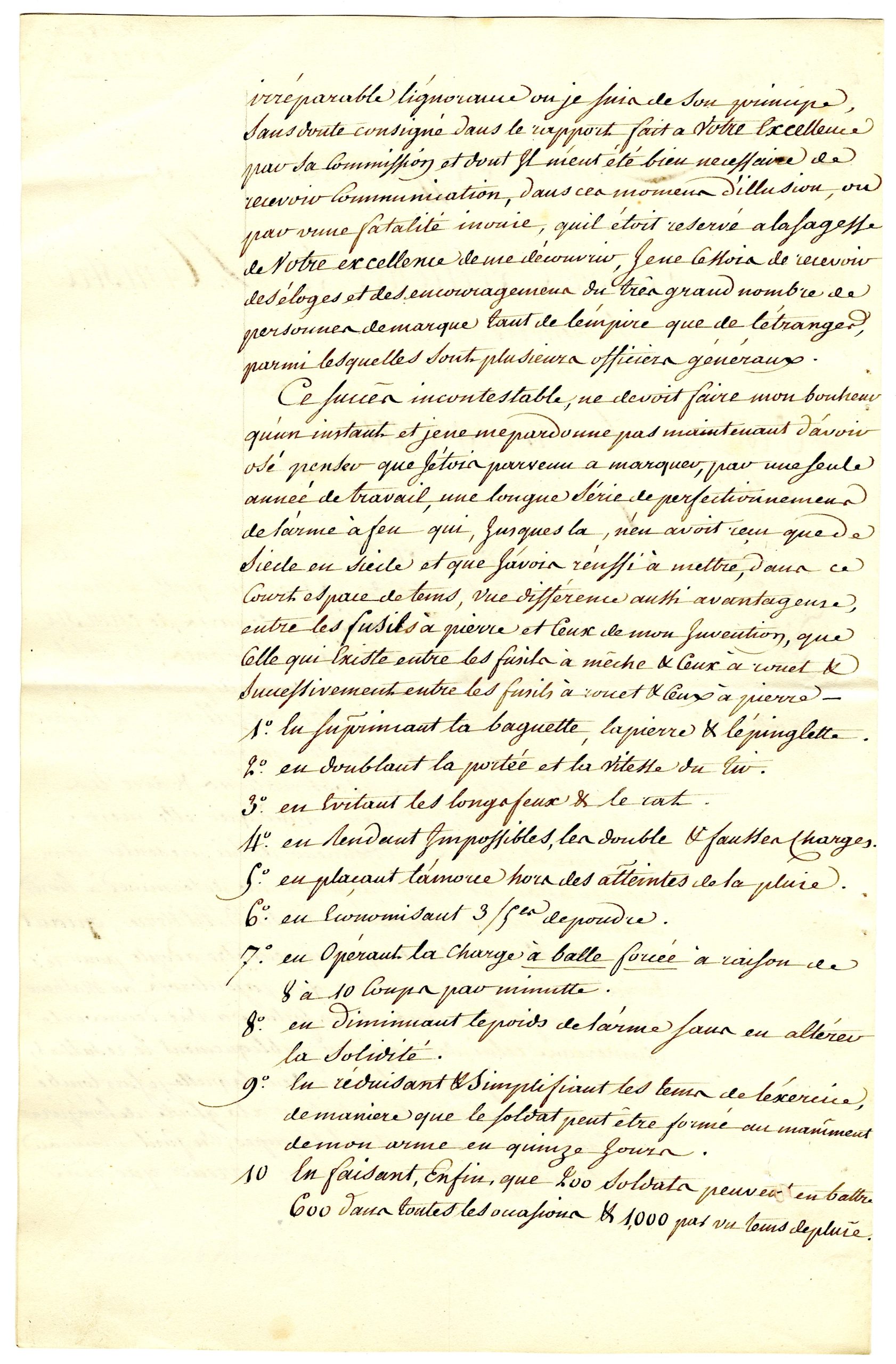
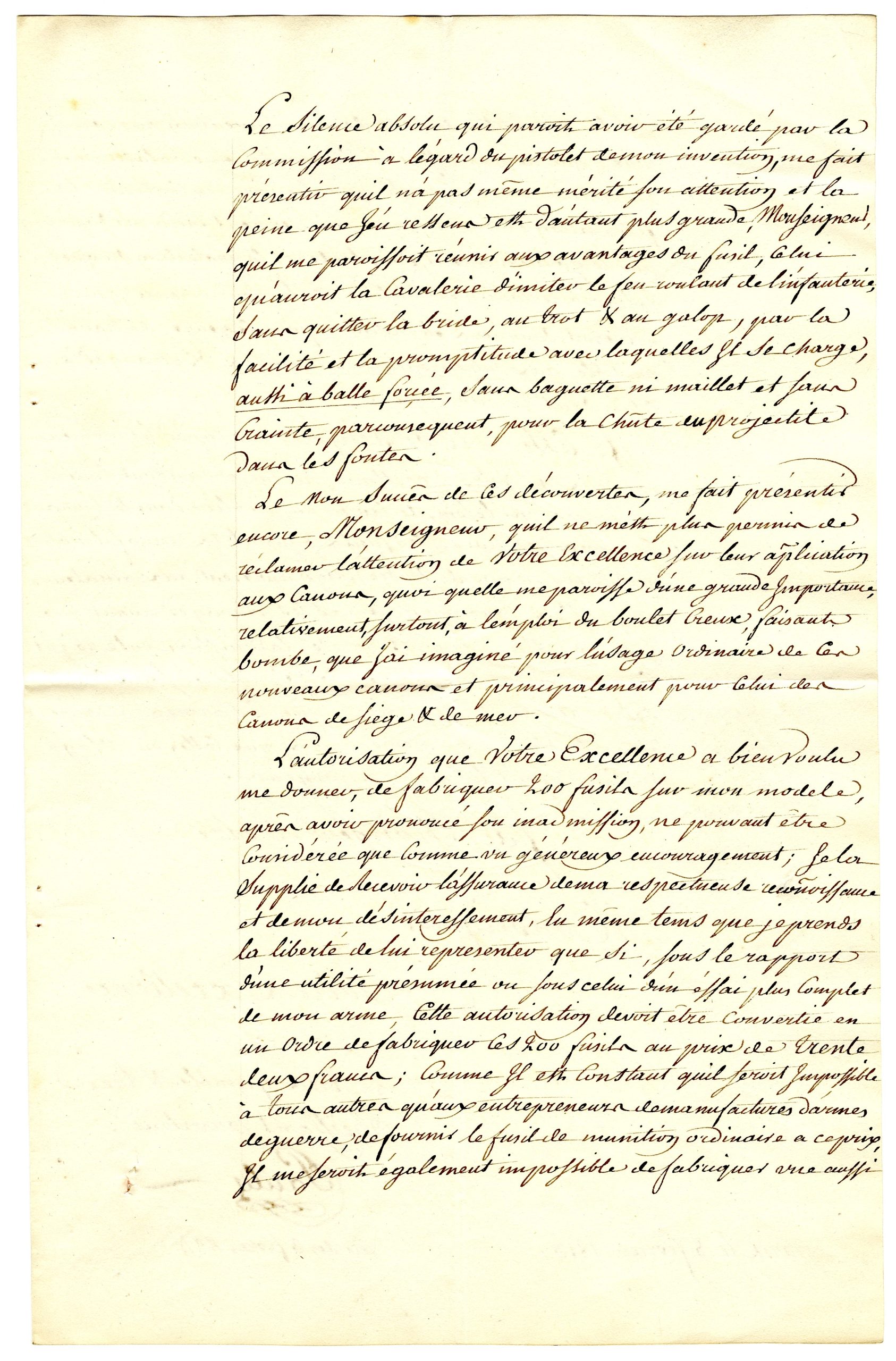
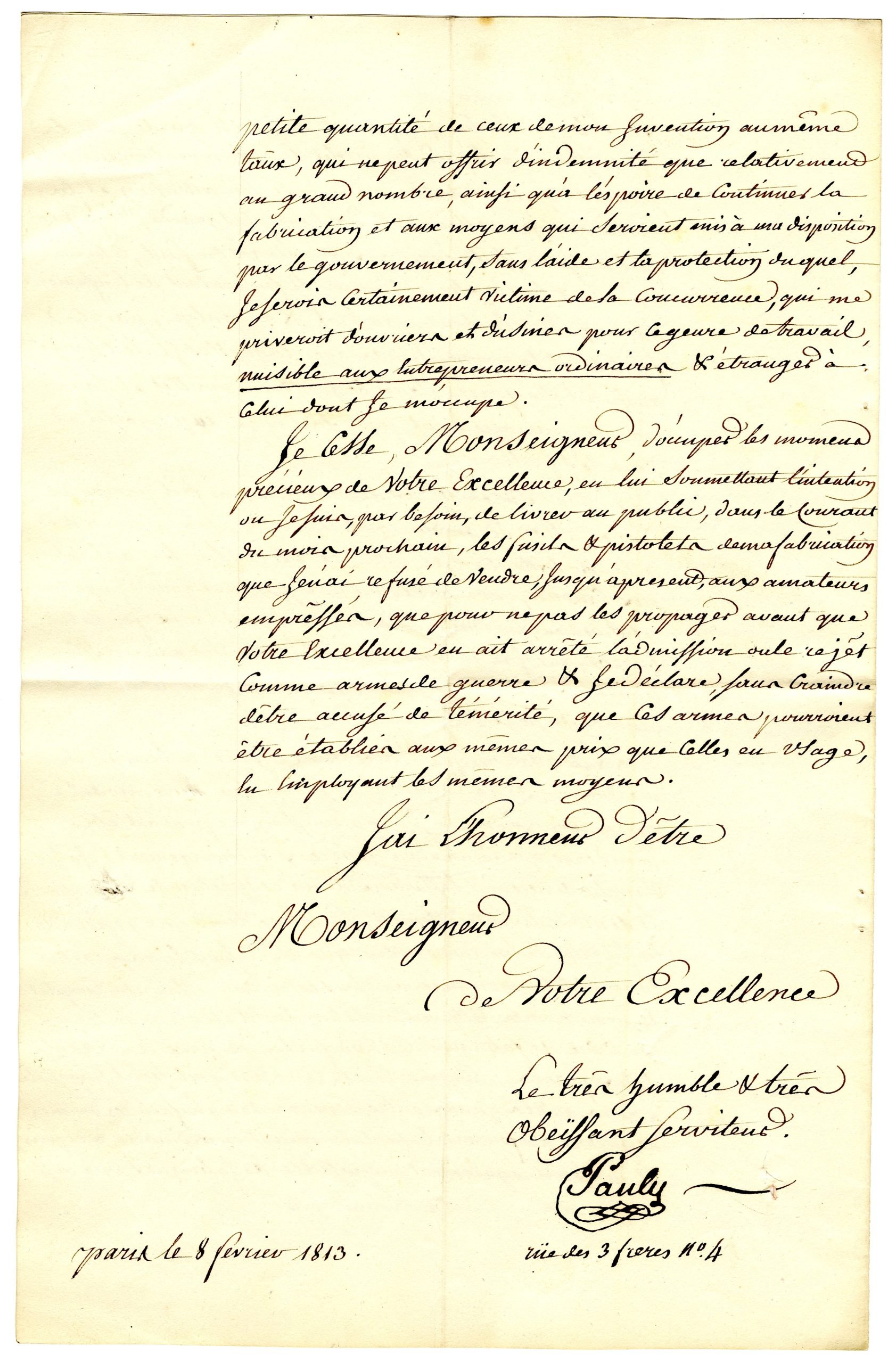
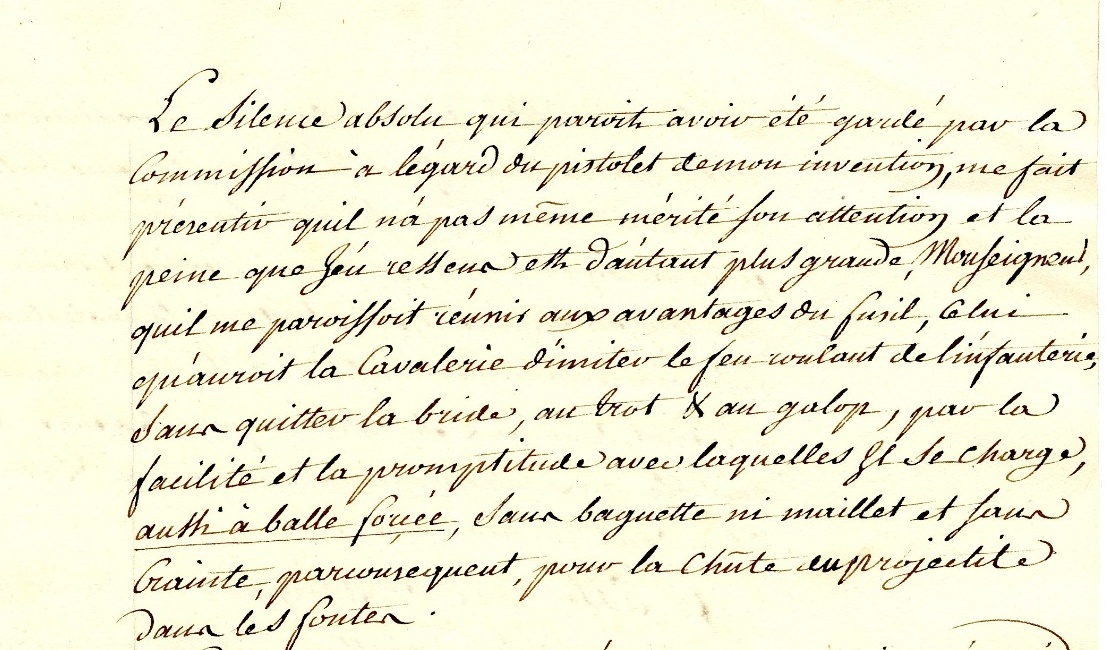
Pauly appears not to have been informed even of that limited consideration. Writing to the minister of war on February 8, 1813, he complained of the “absolute silence” maintained by the commission concerning “the pistol of my invention.” From that silence, he presumed that the pistol had not received its attention.
He believed the omission was important. Pauly argued that his pistol could be loaded rapidly with a tightly fitting ball, without a ramrod or mallet. For a mounted man, that meant the reins need not be abandoned and the loaded projectile could not work loose in the holster in the manner feared with conventional cavalry pistols.
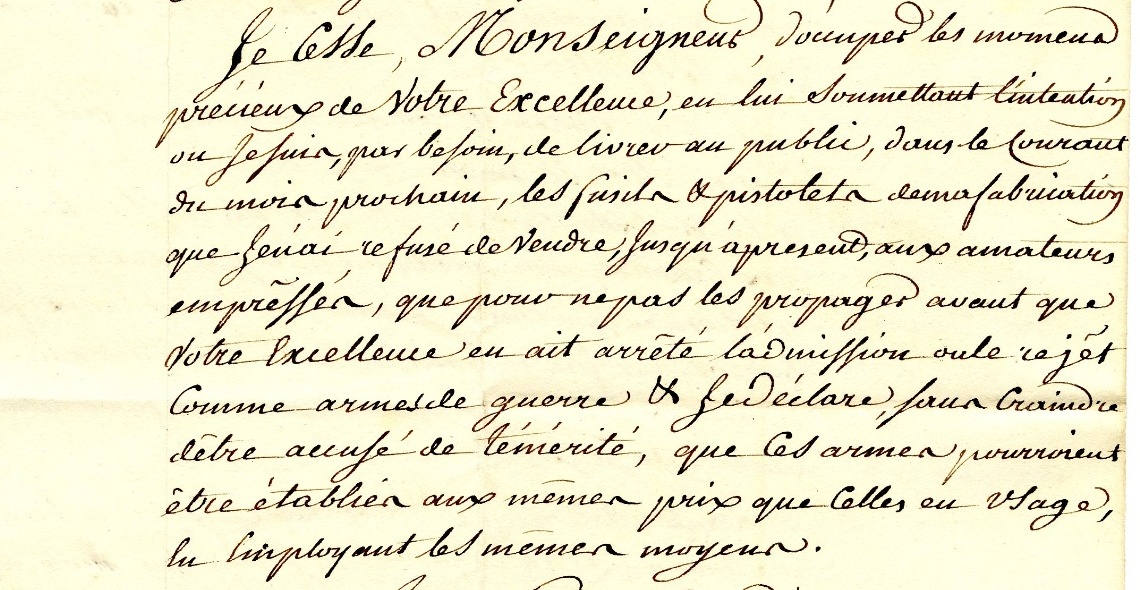
With military adoption stalled, Pauly turned toward another market. In the same letter, he explained that necessity had brought him to the intention of delivering to the public, during the following month, “rifles and pistols of my manufacture.” He had delayed doing so while awaiting a decision on their military use. By March 1813, he intended to place them before private buyers.⁷
Pistol No. 5 is dated to that same year.

A pistol made around its cartridge
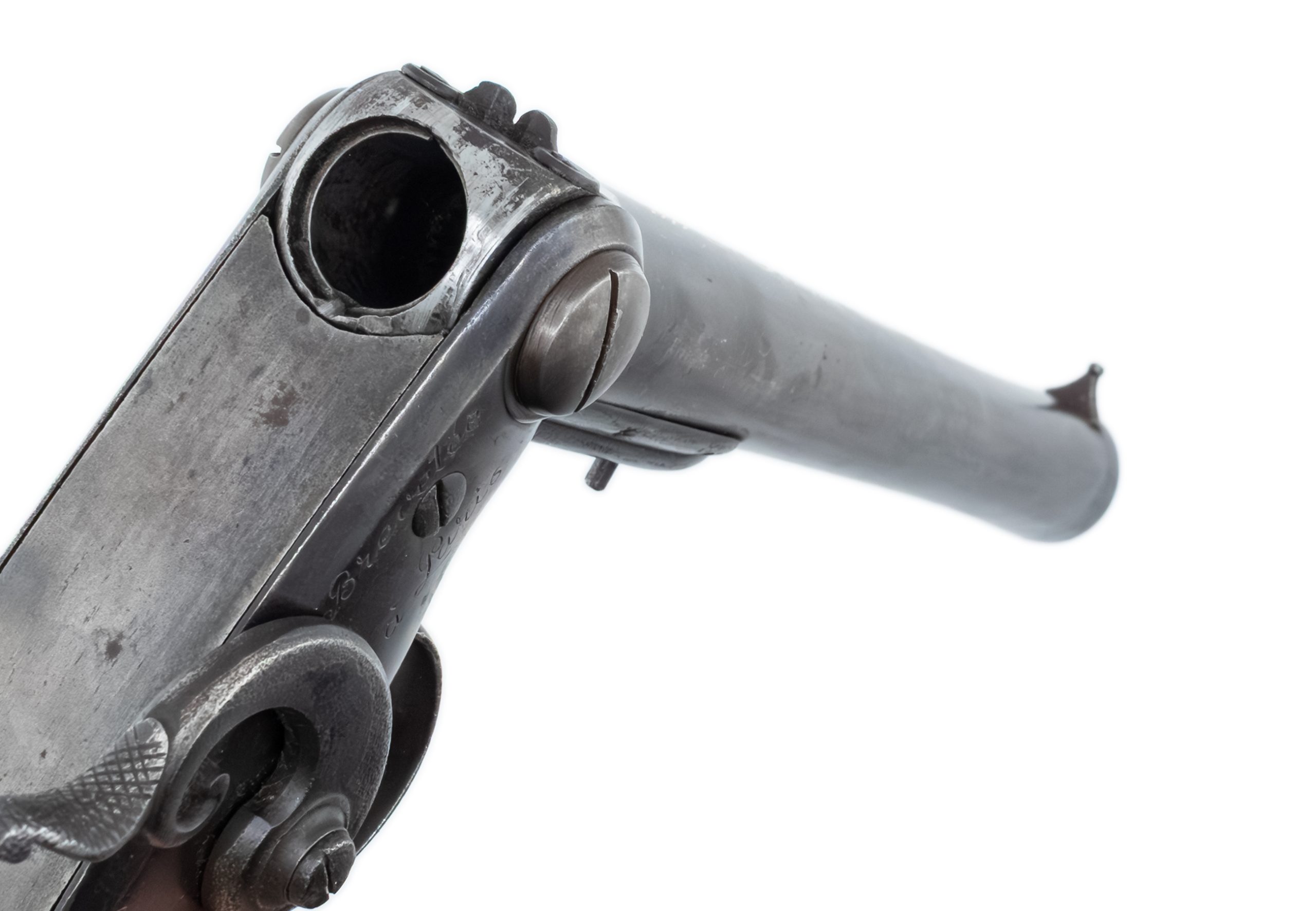
The pistol reveals Pauly’s system most clearly when it is opened. Its barrel pivots downward around the large transverse joint at the front of the frame, exposing the chamber at the rear. A complete cartridge is inserted directly into this opening, after which the barrel is returned to alignment with the frame and secured for firing.
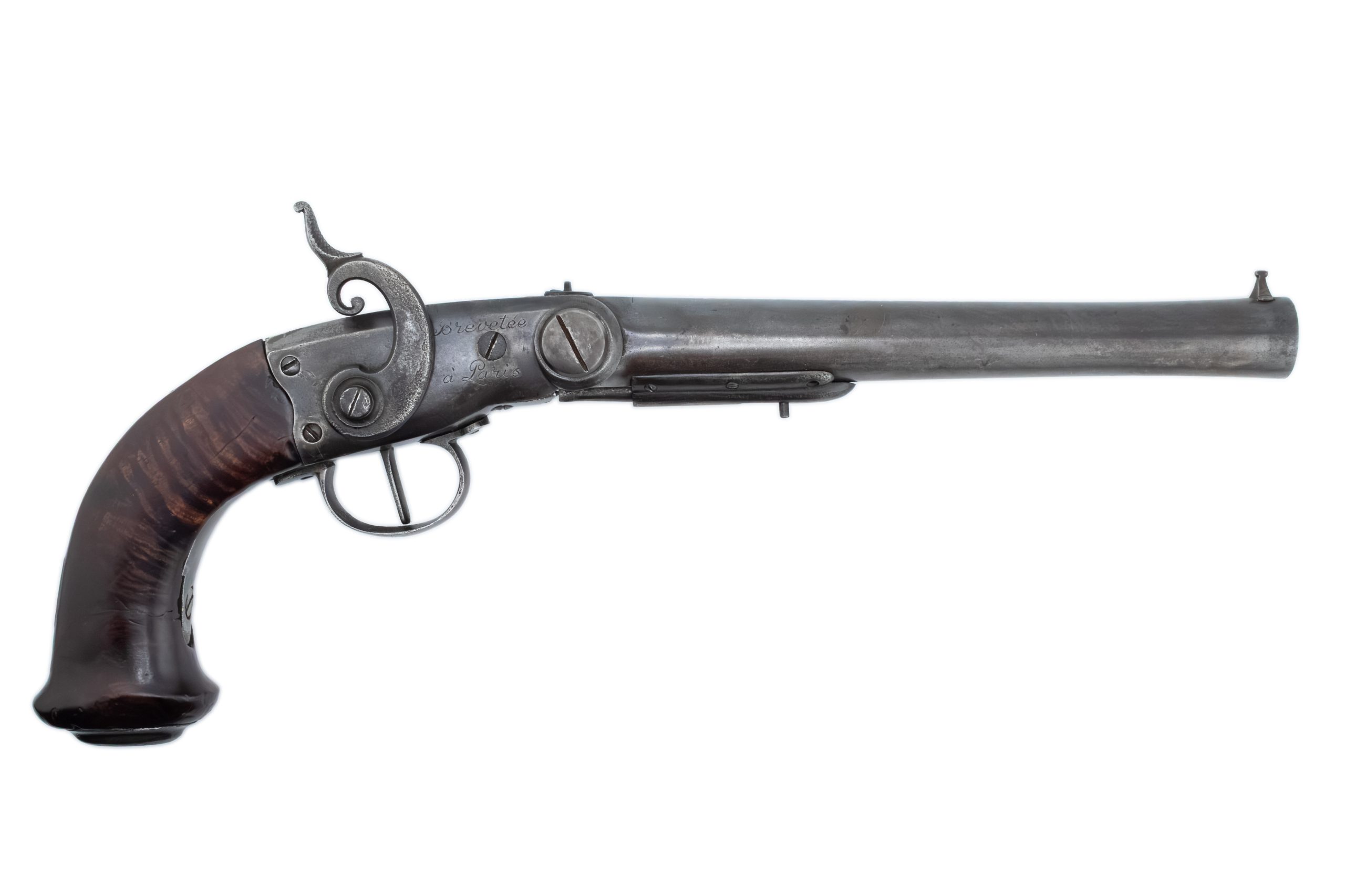
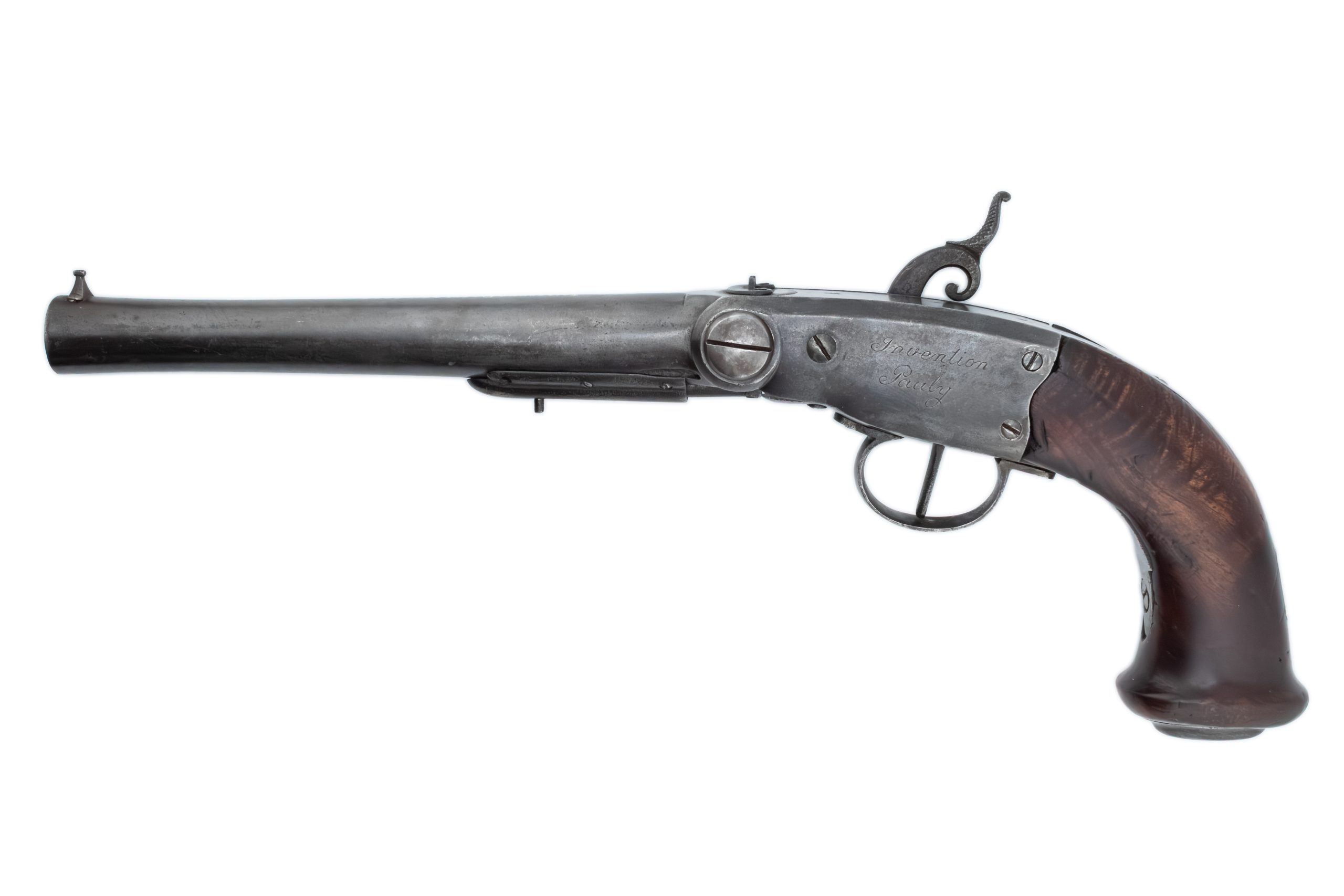
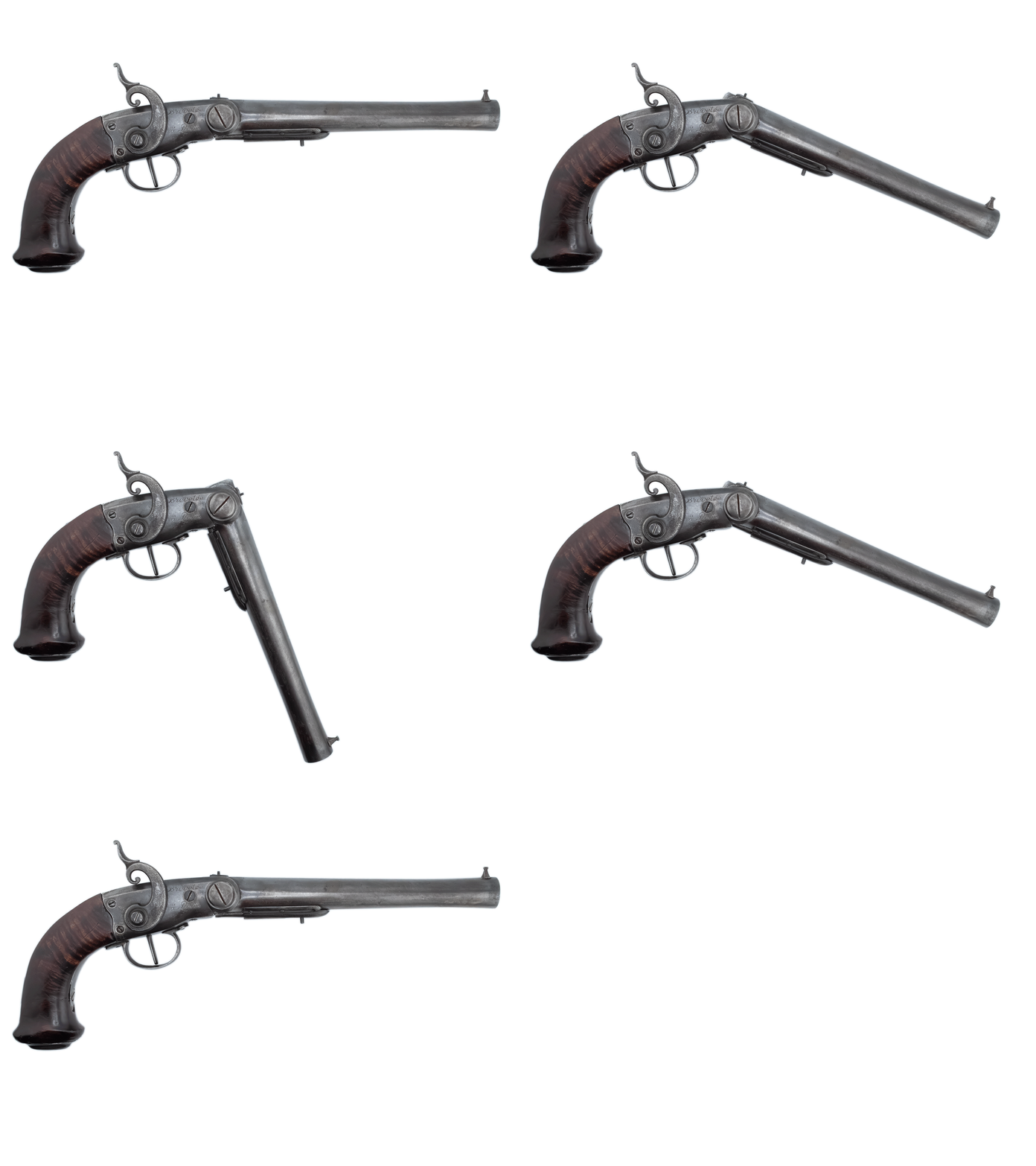
The curled external piece resembles a hammer, although the important work takes place inside the action. Cocking it tensions the enclosed mechanism. Pulling the trigger releases the internal piston or striker, which acts upon the primer carried in the cartridge base. There is no flint, no exposed priming pan, and no separate operation to prime the pistol before each shot.
Pauly’s name and claim appear repeatedly across the arm. The barrel carries the gold-inlaid inscription “INVon PAULY,” an abbreviation of Invention Pauly, framed by decorative arrows. One side of the action is engraved “Invention Pauly,” while the other reads “Breveté à Paris.” The wording identifies both the inventor and the patented system. The internal date and matching number then connect that exterior claim to a specific arm made during Pauly’s earliest period of public production.
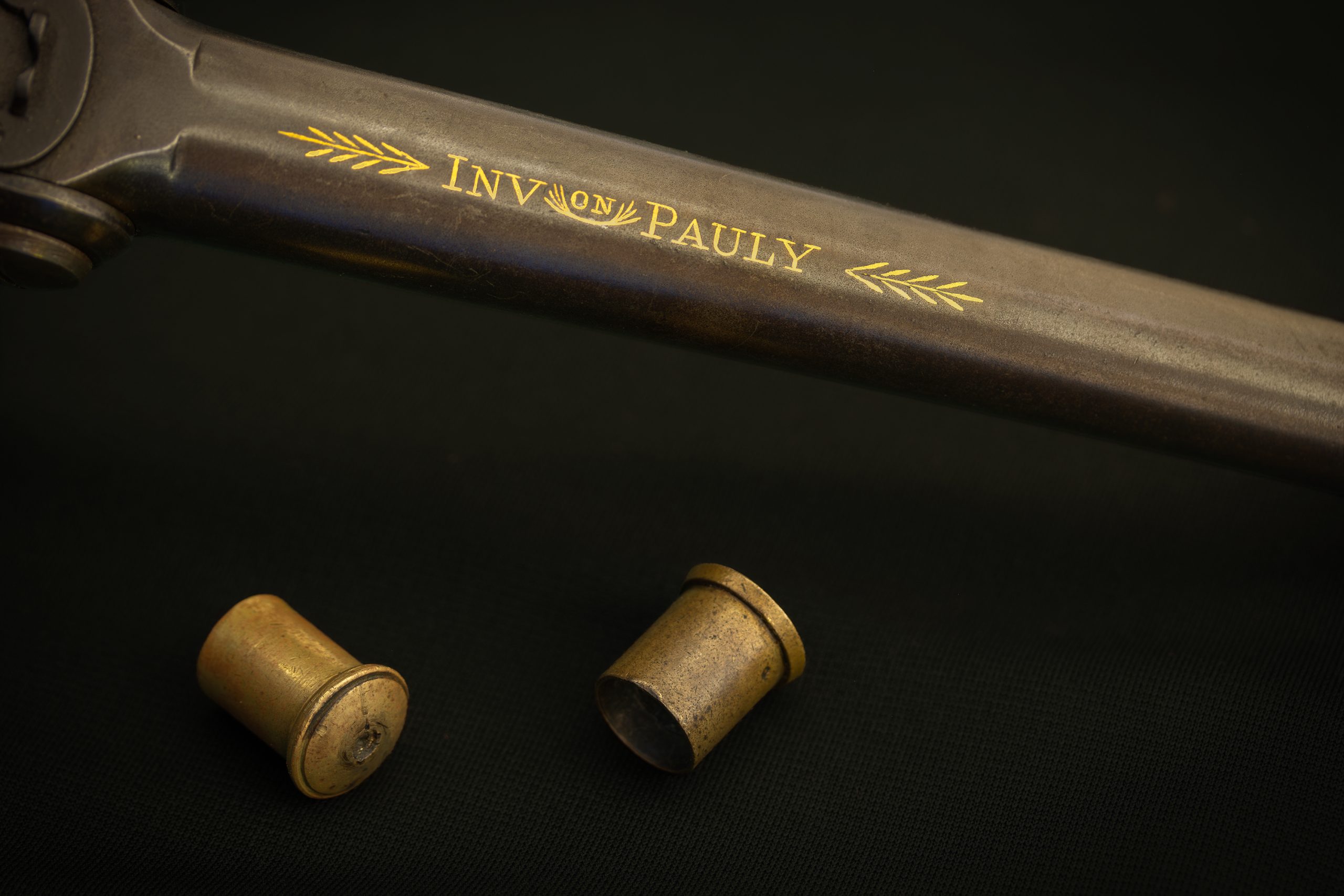
The barrel is rifled, reflecting Pauly’s concern with accuracy as well as speed of loading. Rifling was particularly practical in a breechloader because the projectile could fit the bore closely without being forced down the full length of the barrel from the muzzle. Pauly emphasized this advantage when describing a pistol that could be loaded with a tightly fitting ball without ramrod or mallet.
A barrel lock absent from the patent
The most unusual part of No. 5 lies beneath its barrel. A narrow longitudinal slider runs along the underside and serves to secure and release the barrel. Moving it frees the barrel to rotate downward for loading; returning it holds the barrel in its firing position.
Among the surviving Pauly pistols I have examined or located, this is the only example with such an under-barrel locking arrangement.
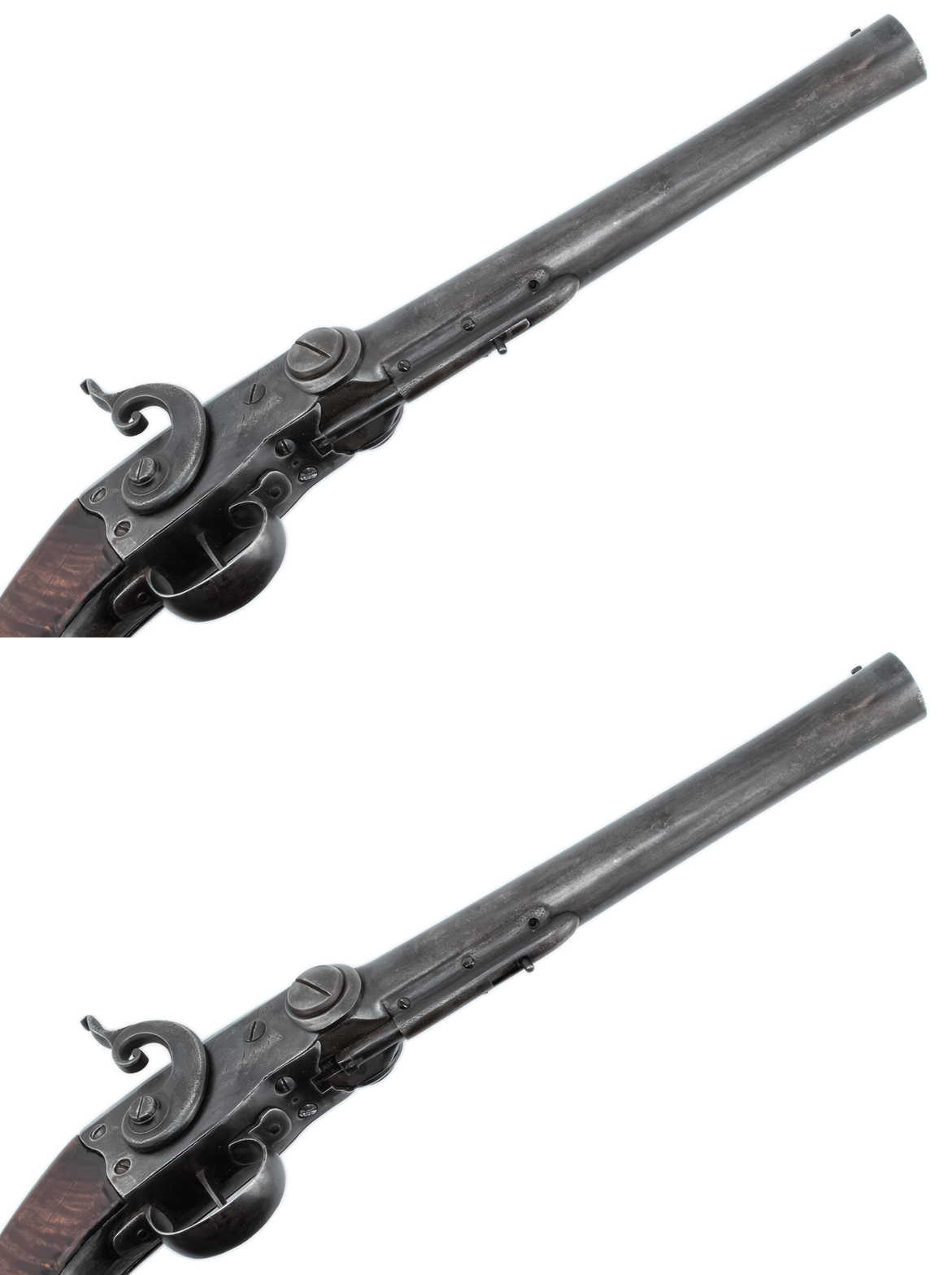
It helps answer a question left open by Pauly’s earliest documentation. The 1812 patent shows the pistol opening at the breech, but the surviving description never explains how the barrel was secured for firing. The mechanism that held the barrel in line with the breech and striker is simply not described.
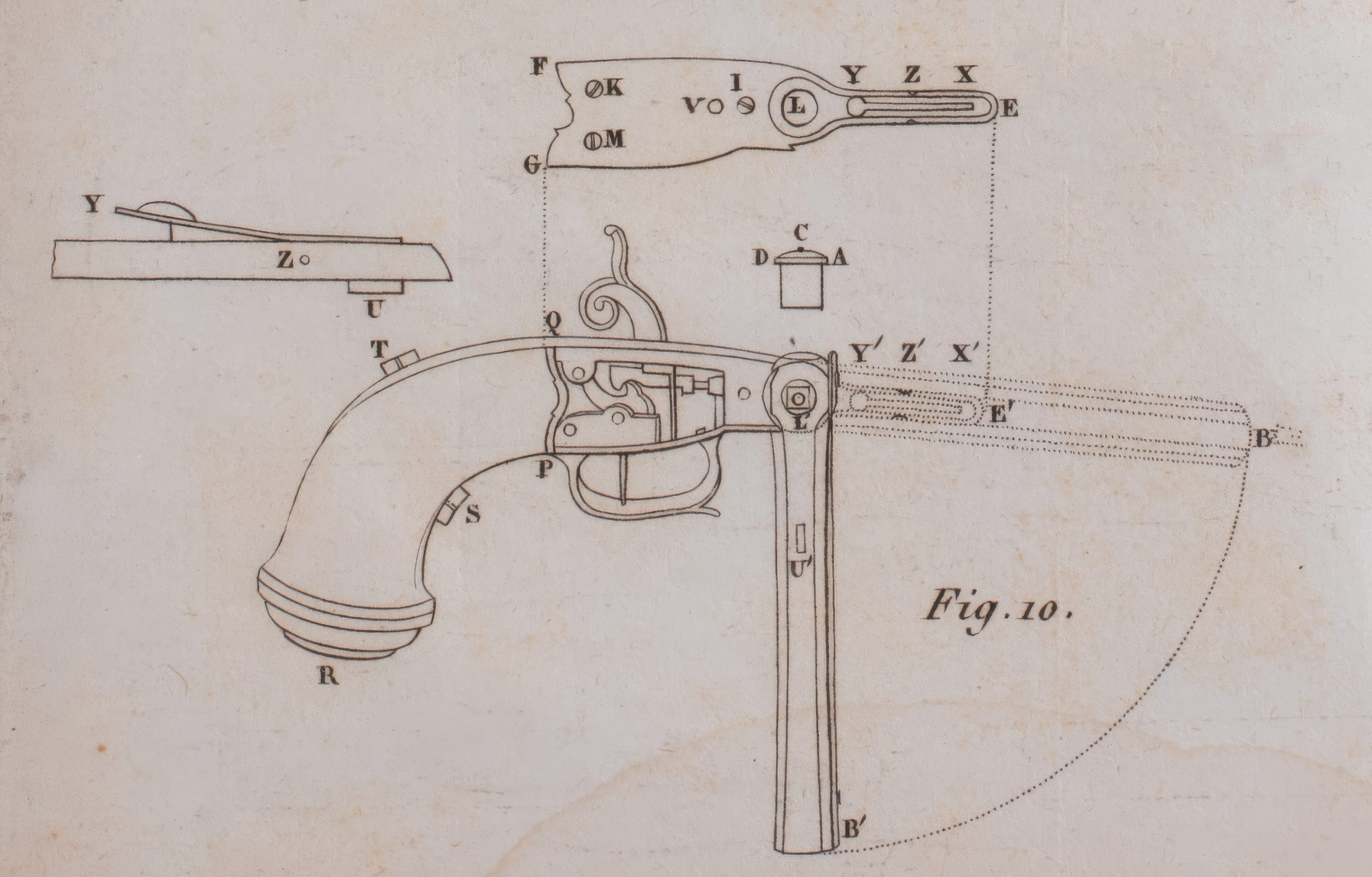
Later documentation shows a different answer. Subsequent drawings, and especially Henri Roux’s 1822 book on Pauly’s percussion system, illustrate and describe the side-mounted catch familiar on other surviving Pauly pistols. In Roux’s account, the right side plate extends forward beyond the barrel pivot and contains a spring-loaded hook. A tooth on that hook enters a small hole in the barrel when the pistol is closed. Pressing a button with the thumb withdraws the tooth, allowing the barrel to rotate downward. Raising the barrel again lets the tooth return to its hole and secure it automatically.⁸
A second early Pauly-system pistol preserves this side mechanism in essentially the form Roux described. Its projecting catch is plainly visible beside the barrel, providing a useful comparison with the unobtrusive slider beneath No. 5.
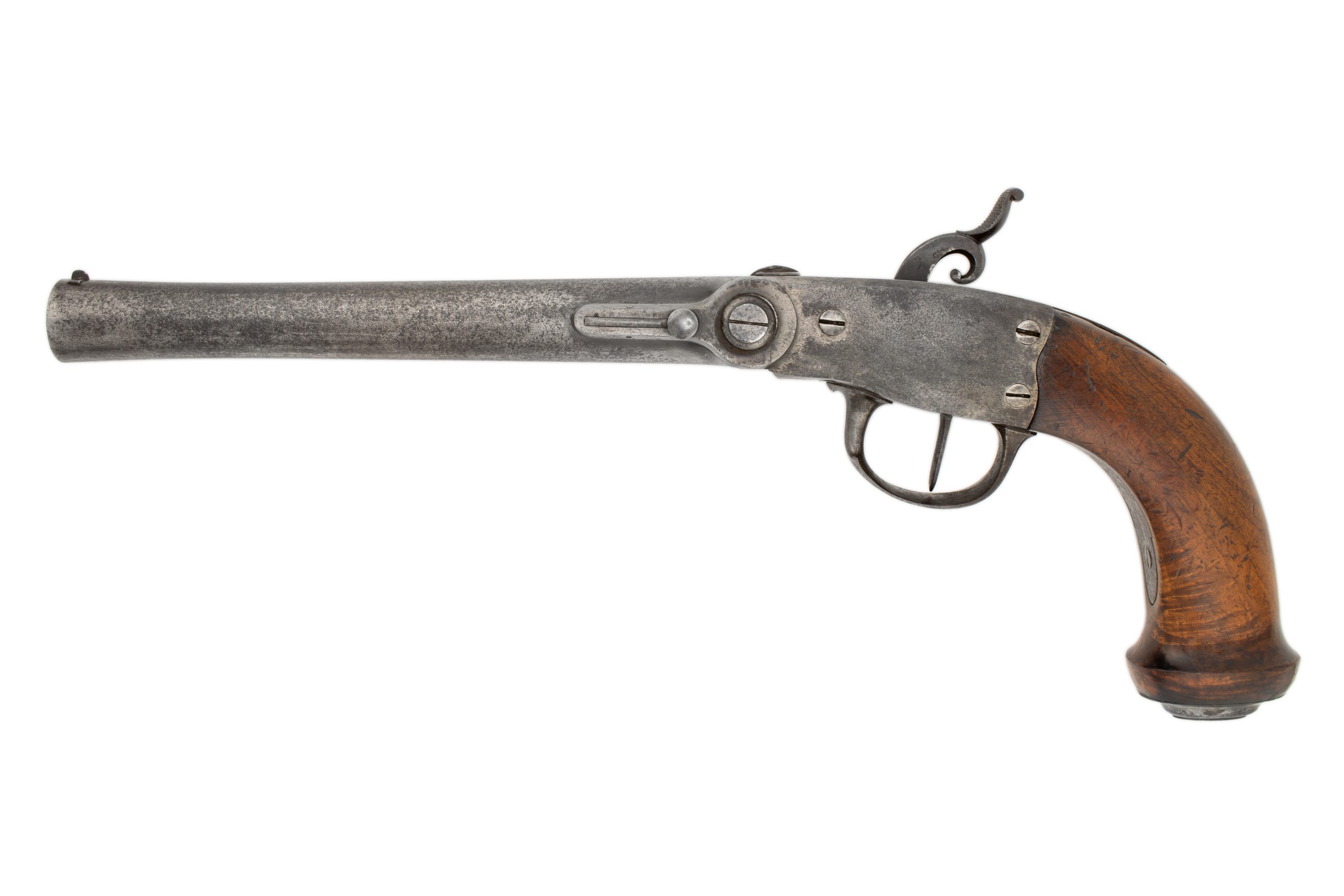
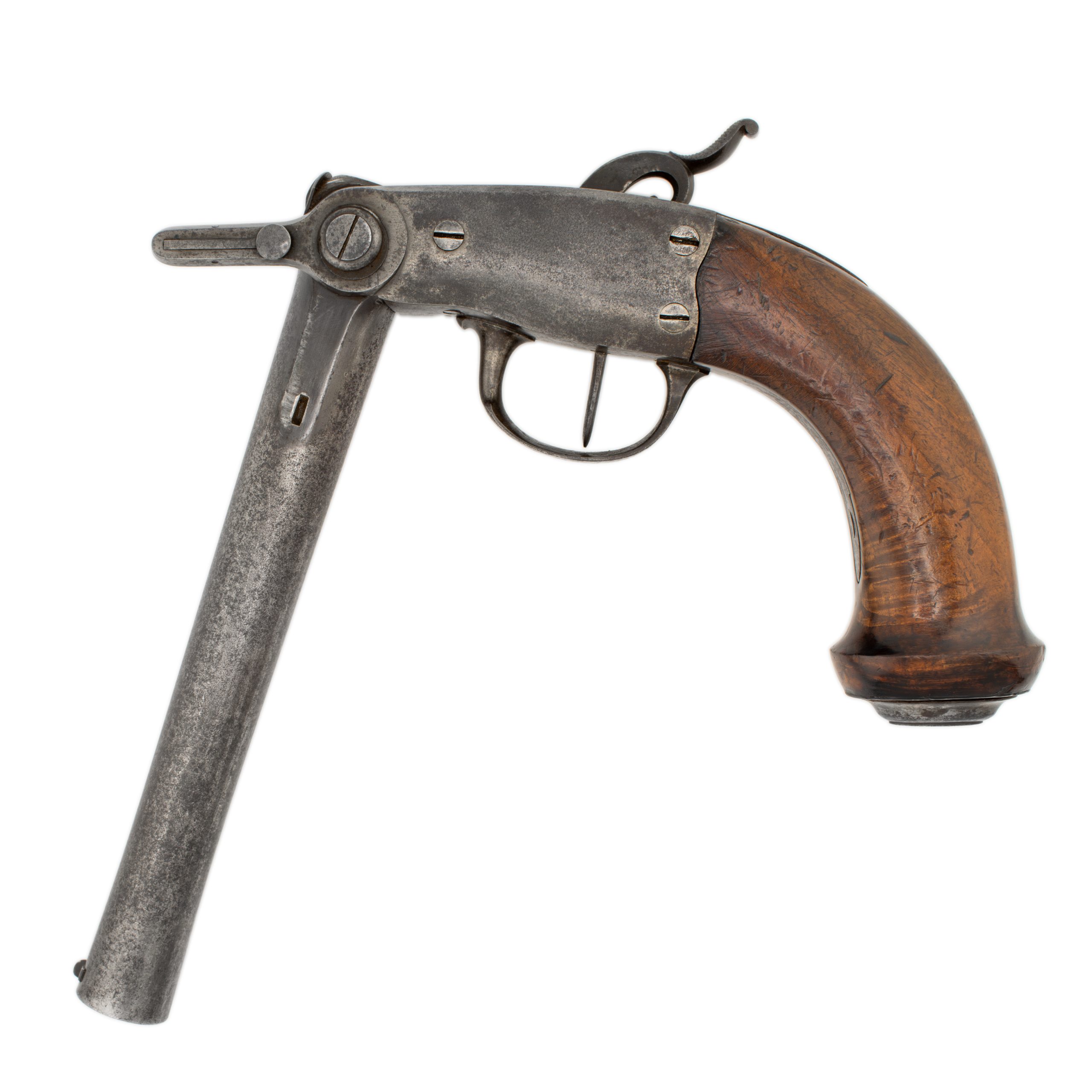
The underlock may represent Pauly’s first solution, a short-lived production variation, or one branch of experimentation during the system’s earliest manufacture. Its 1813 date makes each possibility worth considering. The original patent did not document a barrel lock, and the mechanism that later became standard was arranged on the side. No. 5 preserves another approach from the interval between them.
The locking mechanism was essential to the operation of the pistol. It had to return the barrel to the correct position, hold the chamber firmly closed, and align the cartridge primer with the internal piston. On No. 5, these functions were performed by the sliding underlock. Later Pauly arms transferred them to a side-mounted spring catch, indicating that the fundamental cartridge and ignition system had been established while the means of securing the barrel was still being refined.
No. 5 and the Beginning of Production
The repeated 5 is more than an isolated fitting mark. It appears on the frame and beneath the barrel, identifying the two principal components as belonging together. Two Pauly et Cie shotguns from the same brief period of Paris production, between 1813 and mid-1814, are numbered 52 and 53. Those consecutive numbers strongly indicate that Pauly’s workshop employed sequential numbering on completed firearms. In this context, the 5 on the pistol is best understood both as an assembly identifier and as a record of the arm’s place within Pauly’s early numbered production.
Without a surviving production ledger, the scope of Pauly’s numbering system remains unknown. Pistols may have had their own sequence, or the number may have included other firearms made under his system. Earlier prototypes and military trial arms may also have stood outside any production sequence. The number therefore cannot prove that this was the fifth firearm Pauly ever constructed.
The most likely interpretation is that this is Pauly production No. 5, either the fifth pistol in an early pistol series or the fifth firearm in a broader numbered sequence. Because it was made in 1813, as Pauly was moving from military trials and subscription orders into public manufacture, it may be the fifth numbered production firearm built for a cartridge in the modern sense.
This may be the fifth numbered production firearm built for a cartridge in the modern sense.
The number does not stand alone. The pistol’s underlock preserves a design that had entered production before every detail of Pauly’s system had settled into its later form. It solves a problem left unexplained in Pauly’s 1812 patent, but does so differently from the side-mounted catch documented in later patents and by Henri Roux. No. 5 is therefore more than an early specimen of Pauly’s system. It is physical evidence of that system being worked out in metal.
Pauly’s achievement is often presented through patents, drawings, and descriptions of what his system would make possible. No. 5 returns the story to the workbench. Its barrel had to be fitted, its breech sealed, and an effective means found to hold the arm closed. The matching numbers and unusual underlock preserve those decisions in metal. The modern cartridge firearm did not emerge fully formed from a single patent drawing. It took shape through working arms such as this one.
Endnotes
- Jean Samuel Pauly, French patent dossier for a ten-year brevet d’invention, granted September 29, 1812, nos. 771, 1061, and 1372. The dossier includes Pauly’s written specification and drawings of the military gun, sporting gun, and pistol.
- French Ministry of War correspondence and reports concerning the examination of Pauly’s firearms, April–July 1812, Service historique de la Défense, GR 6 W 107. These documents record the appointment of the military commission and its examination of Pauly’s system.
- Jean Samuel Pauly, “Exposé du Sr Pauly mécanicien,” submitted with his 1812 patent application. Pauly expressly included two new guns, a new pistol, and specially constructed cartridges adapted to these arms.
- “Notice sur de nouvelles Armes à feu inventées par M. Pauly” and Baron Delessert, “Rapport fait par M. le Baron Delessert, sur un nouveau Fusil de l’invention de M. Pauly,” Bulletin de la Société d’encouragement pour l’industrie nationale, 11th year, no. XCIX (September 1812), pp. 203–206. The notice discusses Pauly’s military and sporting guns, combat pistol, and cartridges; Delessert’s report explains that Pauly sought presentation before the Society as the surest means of making the system known.
- Gazette de France, December 1, 1812. The notice refers to newspaper reports dated November 8 and 9 and states that Pauly and Company had received orders from throughout the Empire and abroad. Customers were invited to obtain numbered places in a subscription organized around anticipated delivery dates.
- Report of the military commission on Pauly’s newly invented firearm, Paris, December 9, 1812, Service historique de la Défense, GR 6 W 107. The report evaluates the rifle at length and concludes with a shorter assessment of Pauly’s combat pistol, recommending against the military adoption of either arm.
- Jean Samuel Pauly to the French minister of war, Paris, February 8, 1813, Service historique de la Défense, GR 6 W 107. Pauly complains of the commission’s “absolute silence” concerning his pistol, describes its advantages for mounted use, and announces his intention to offer rifles and pistols of his manufacture to the public during the following month.
- Henri Roux, Des fusils de chasse, et principalement des fusils à pistons de l’invention Pauly, avec quelques observations sur la fabrication des armes à feu, sur la chasse, sur la poudre et ses effets (Paris: Delaunay and Mongie, 1822). Roux illustrates and describes the spring-loaded side catch used to secure the barrels of later Pauly-system pistols.